A New Era of Subtle, High‑Tech Aesthetics
Across the United States, patients are gravitating toward minimally invasive cosmetic solutions that promise quick recovery, minimal discomfort, and subtle, natural‑looking enhancements. Neuromodulators such as Botox and hyaluronic‑acid fillers dominate the market, delivering personalized smoothing and volumizing without incisions. This shift reflects a broader desire for results that preserve individual facial character while addressing early signs of aging. In New York City, boutique practices exemplify this philosophy by offering concierge‑level consultations, 3‑D imaging simulations, and customized treatment plans crafted by board‑certified surgeons. The combination of cutting‑edge technology and attentive, safety‑first care creates a luxurious experience that restores confidence with elegance.
Current Landscape of Minimally Invasive Cosmetic Procedures
Key Statistics (2023‑2024)
| Metric | 2023 | 2024 (proj.) |
|---|---|---|
| Total minimally invasive procedures | 12 million (78 % of all aesthetic treatments) | — |
| Neuromodulator injections (Botox, Dysport, Xeomin, Jeuveau) | >9 million | +4 % growth |
| Hyaluronic‑acid filler injections | >5 million | — |
| Complication rate (FDA‑cleared) | <0.5 % | — |
| Typical downtime | Same‑day return to activities | — |
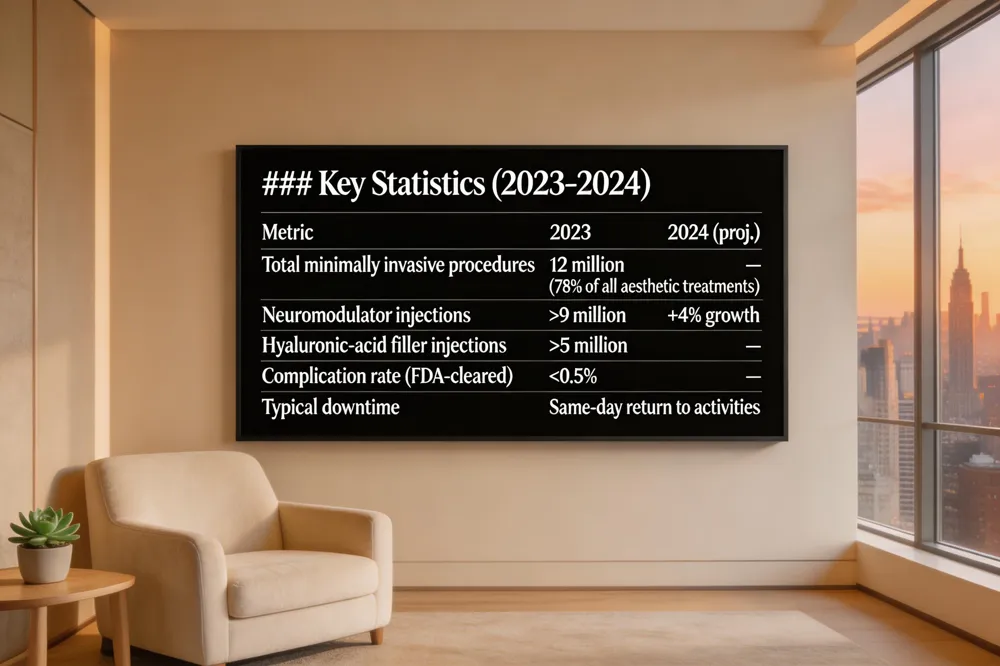 In the United States, minimally invasive facial treatments dominate the aesthetic market. Neuromodulator injections—most notably Botox® withand its equivalents Dysport®, Xeomin®, Jeuveau®—remain the top non‑surgical procedures, accounting for over 9 million treatments in 2023 and continuing to grow 4 % in 2024. Hyaluronic‑acid dermal fillers follow closely, with more than 5 million injections that restore volume to cheeks, lips, and under‑eye hollows while delivering immediate, natural‑looking results.
Key benefits that drive this popularity include exceptionally short recovery periods—often a return to daily activities within the same day—low post‑procedure pain, and a complication rate below 0.5 % for FDA‑cleared products. The combination of neuromodulators and fillers produces a “liquid facelift,” offering comprehensive rejuvenation without incisions, scarring, or prolonged downtime.
Statistical data underscore the surge: minimally invasive cosmetic procedures represented 78 % of all aesthetic treatments in 2023, with Botox and fillers alone comprising a combined 12 million procedures. This shift reflects patients’ preference for subtle, natural enhancements that preserve individual facial identity while delivering confidence‑boosting outcomes.
What is the most popular plastic surgery procedure in the United States in 2024? Liposuction topped the ASPS 2024 statistics as the most frequently performed cosmetic surgery, reflecting continued demand for body‑contouring with minimal downtime and natural results.
Which non‑surgical cosmetic procedures for the face are most popular? Botox and Dysport (neuromodulators) lead, followed closely by hyaluronic‑acid fillers such as Juvéderm® and Restylane®. Complementary options include chemical peels, RF‑microneedling, laser resurfacing, and IPL/Broadband Light treatments, all prized for their ability to rejuvenate skin with minimal recovery.
Top Non‑Surgical Aesthetic Treatments in New York City
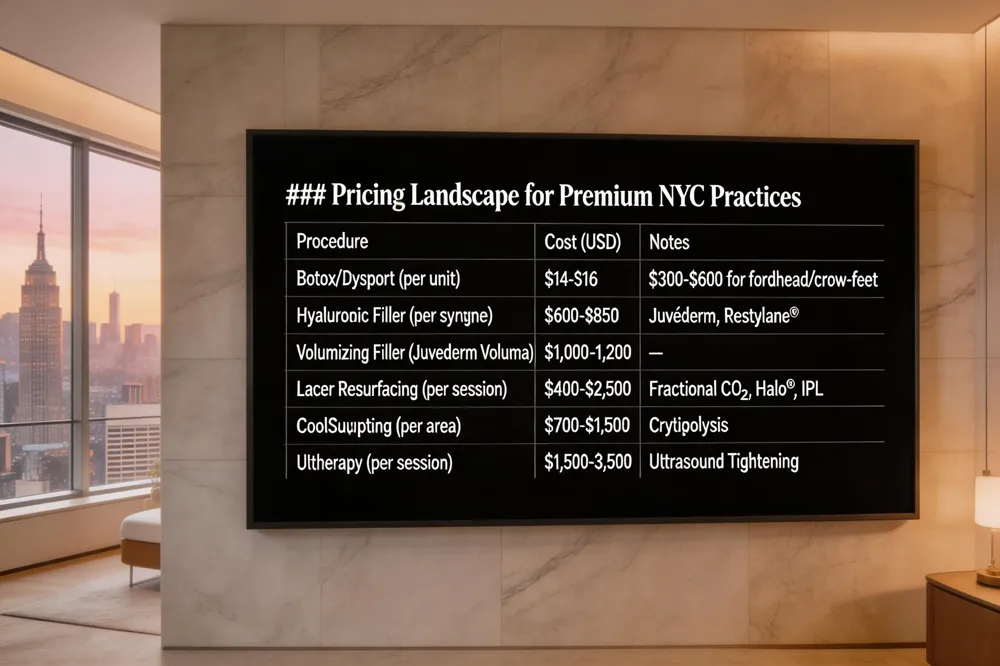
Pricing Landscape for Premium NYC Practices
| Procedure | Typical Unit / Session Cost (USD) | Notes |
|---|---|---|
| Botox/Dysport (per unit) | $14‑$16 | $300‑$600 for a typical forehead or crow‑foot set |
| Hyaluronic filler (per syringe) | $600‑$850 | Juvéderm®, Restylane® |
| Volumizing filler (e.g., Juvederm Voluma) | $1,000‑$1,200 | — |
| Laser resurfacing (per session) | $400‑$2,500 | Fractional CO₂, Halo®, IPL |
| CoolSculpting (per area) | $700‑$1,500 | Cryolipolysis |
| Ultherapy (per session) | $1,500‑$3,500 | Ultrasound tightening |
 Neuromodulators and Dermal Fillers
New York’s elite aesthetic clinics begin with FDA‑cleared neuromodulators—Botox®, Dysport®, Xeomin®—to relax dynamic lines for three‑to‑six months. Hyaluronic‑acid fillers such as Juvédém®, Restylane® and Radiesse® restore volume, sculpt lips, cheeks and nasolabial folds, while biostimulatory agents (Sculptra®) and deoxycholic‑acid injections (Kybella®) address deeper hollows and submental fat.
Neuromodulators and Dermal Fillers
New York’s elite aesthetic clinics begin with FDA‑cleared neuromodulators—Botox®, Dysport®, Xeomin®—to relax dynamic lines for three‑to‑six months. Hyaluronic‑acid fillers such as Juvédém®, Restylane® and Radiesse® restore volume, sculpt lips, cheeks and nasolabial folds, while biostimulatory agents (Sculptra®) and deoxycholic‑acid injections (Kybella®) address deeper hollows and submental fat.
Advanced Laser, Light, and Energy‑Based Technologies Fractional CO₂, Fraxel®/CO₂RE®, Halo® and IPL systems rejuvenate texture, erase pigment irregularities and stimulate collagen. Radiofrequency microneedling (Morpheus8, Fractora) and ultrasound‑based Ultherapy® tighten skin non the face, neck and décolleté, delivering a surgical‑like lift without incisions.
Body‑Contouring and Skin‑Tightening Options CoolSculpting® (cryolipolysis) and EmSculpt Neo combine controlled cooling or HIFEM with RF to melt stubborn fat and tone muscle, while ultrasound‑guided micro‑fat‑transfer offers precise volumization without surgical scars.
Pricing Landscape for Premium NYC Practices Boutique Manhattan practices charge $14‑$16 per Botox unit ($300‑$600 for a typical forehead or crow‑foot set). Hyaluronic fillers run $600‑$850 per syringe; volumizing products such as Juvederm Voluma $1,000‑$1,200. Laser resurfacing $400‑$2,500 per session; CoolSculpting $700‑$1,500 per area; Ultherapy $1,500‑$3,500. Prices reflect board‑certified expertise, FDA‑cleared products and personalized care.
What are the best non‑surgical aesthetic treatments available in New York City? The premier options combine neuromodulators, hyaluronic fillers, advanced laser/IPL, RF microneedling, Ultherapy and non‑invasive body‑contouring to achieve natural, elegant results with minimal downtime.
What are the top five non‑surgical cosmetic procedures in 2024?
- Botox/Dysport neuromodulator injections
- Hyaluronic‑acid dermal fillers
- Laser skin resurfacing (fractional CO₂, Halo, IPL)
- Cryolipolysis (CoolSculpting)
- Ultherapy ultrasound tightening
What are the typical costs for non‑surgical aesthetic treatments in New York City? Injectables range from $300‑$600 per Botox set to $600‑$1,200 per filler syringe. Laser and RF sessions cost $400‑$2,500; CoolSculpting $700‑$1,500 per area; Ultherapy $1,500‑$3,500 per session, with pricing varying by provider expertise and product brand.
Emerging Technologies Shaping Minimally Invasive Care
Emerging Technologies & Their Benefits
| Technology | Application | Key Benefit |
|---|---|---|
| 3‑D imaging & AR/VR | Pre‑operative simulation | Precise anatomy mapping, real‑time patient approval |
| AI‑driven outcome prediction | Treatment planning | Forecast volumetric change, reduce variability |
| Robotic‑assisted precision | Filler placement, RF microneedling | Micron‑level control, lower complication rates |
| Advanced RF microneedling & ultrasound (Morpheus8, Sofwave) | Collagen stimulation | Up to 30 % more collagen, quick recovery |
| Regenerative adjuncts (PRP, exosomes, Sculptra) | Combined with energy devices | Accelerated remodeling, longer durability |
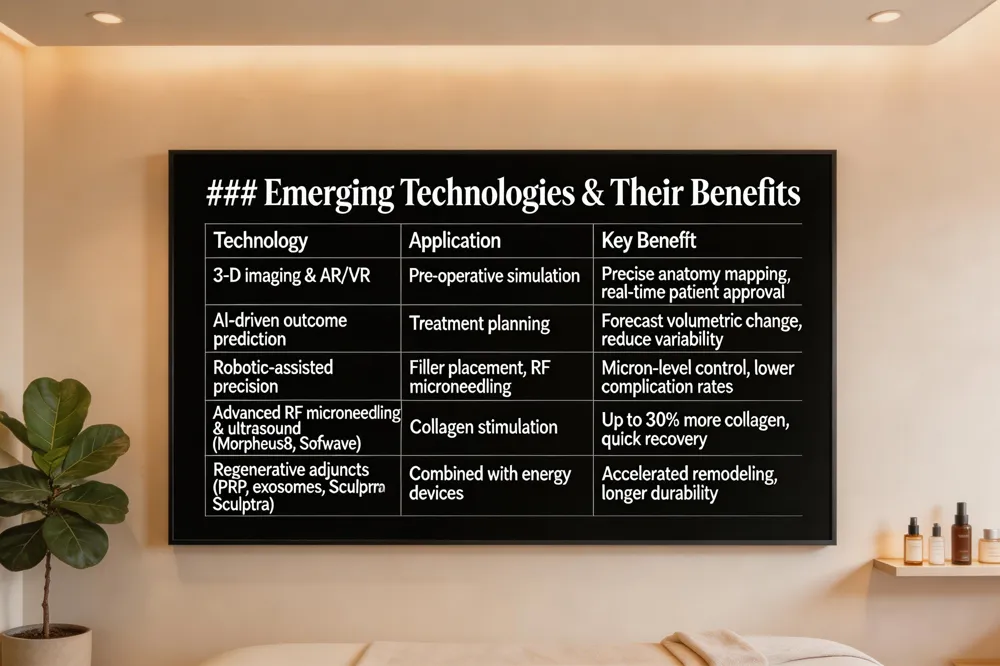 The United States aesthetic market is being re‑engineered by a suite of cutting‑edge tools that permit clinicians to deliver subtle, natural‑looking results with unprecedented safety and efficiency.
3‑D imaging, virtual and augmented reality now enable physicians to construct a holographic map of a patient’s facial anatomy, allowing a precise pre‑operative simulation that patients can view and approve in real time. This visual fidelity reduces guesswork and aligns expectations with achievable outcomes.
AI‑driven outcome prediction builds on that imaging by analyzing millions of treatment data points to forecast volumetric changes, wrinkle reduction and collagen remodeling, thereby guiding injector placement and energy‑device settings for optimal consistency.
Robotic‑assisted precision augments surgeon dexterity in confined anatomic corridors, delivering micron‑level control during filler placement or Radiofrequency microneedling and ultrasound devices, which translates into lower complication rates and more predictable lift.
Radiofrequency microneedling and ultrasound devices such as Morpheus8, Exilis Ultra and the newer Sofwave platform now combine controlled thermal injury with micro‑channel creation, stimulating up to 30 % more collagen than earlier generations while preserving a quick, downtime‑free recovery.
Regenerative adjuncts – platelet‑rich plasma, exosome‑infused serums and biostimulatory agents like Sculptra – are being layered onto energy‑based treatments to accelerate tissue remodeling, improve elasticity and extend the durability of results.
What does the 2024 ASPS Procedural Statistics Release reveal? It shows a 3 % overall rise in minimally invasive procedures, driven by a 9 % surge in neuromodulators and dermal fillers, while facial rejuvenation remains the most requested surgical category.
What new surgical techniques are shaping plastic surgery today? Emerging methods include 3‑D imaging and virtual‑reality surgical planning, robotic‑assisted microsurgery, minimally invasive endoscopic facial lifts, and bio‑engineered tissue scaffolds for reconstruction.
Together, these innovations empower board‑certified surgeons to deliver boutique‑level, personalized care that meets the discerning expectations of today’s aesthetic patients.
Hybrid & Regenerative Approaches: From Liquid Facelift to PRP
Hybrid & Regenerative Protocols
| Protocol | Components | Typical Session Length | Primary Outcomes |
|---|---|---|---|
| Liquid Facelift | Neuromodulators (Botox/Daxxify) + high‑G' HA fillers | 30‑45 min | Smooth dynamic lines, restore volume |
| RF Microneedling + PRP | RF device (Morpheus8) + autologous PRP | 45‑60 min | Enhanced collagen/elastin, scar improvement |
| Non‑surgical Breast Lift | RF (Thermage/BodyTite) or ultrasound + optional laser | 30‑45 min | Tighten skin, modest lift for mild ptosis |
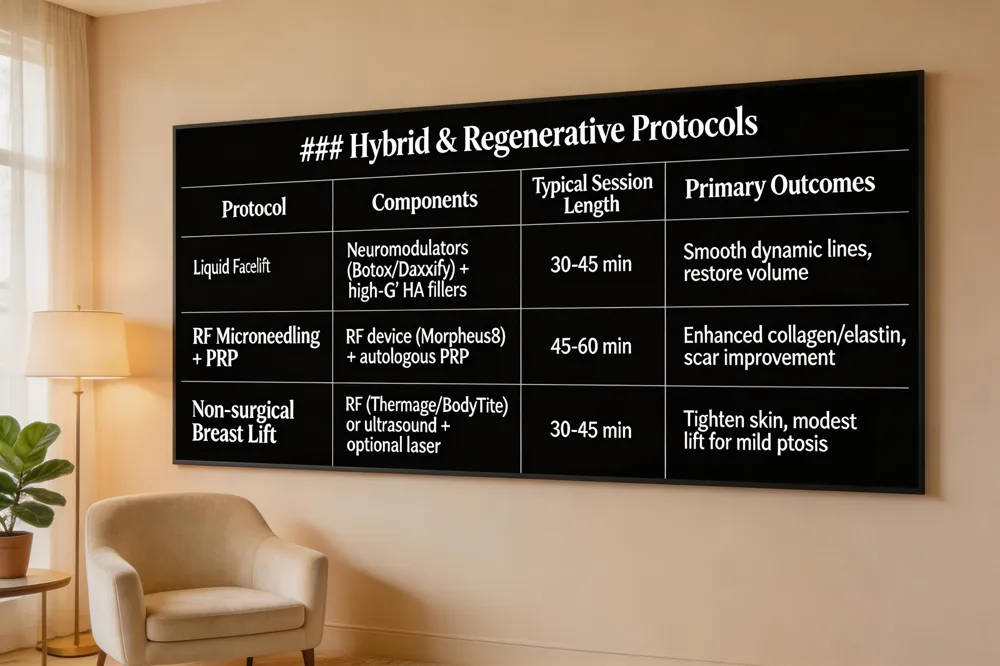 The modern boutique aesthetic practice now offers a "liquid facelift"—a coordinated protocol that blends neuromodulators (Botox, Daxxify) with high‑G' hyaluronic‑acid fillers to smooth dynamic lines, restore volume, and enhance skin texture in a single office visit. This synergistic approach yields a subtle, natural‑looking rejuvenation without incision or downtime.
Radiofrequency (RF) microneedling combined with platelet‑rich plasma (PRP) further amplifies collagen and elastin synthesis, delivering deeper dermal remodeling for fine lines, acne scarring, and laxity on the face, neck, or décolletage.
Non‑surgical breast lift technologies—Thermage, BodyTite™ and Renuvion (J‑Plasma), and emerging ultrasound‑based devices—tighten the chest wall by stimulating collagen and contracting existing fibers, offering a modest lift for patients with mild ptosis.
Over the past decade, patient preferences have shifted from aggressive surgical lifts to refined, minimally invasive solutions that prioritize natural results, quick recovery, and personalized care. This evolution is driven by advances in 3D imaging, AI‑guided planning, and energy‑based devices that empower board‑certified surgeons to deliver elegant, lasting outcomes.
What is the deep‑plane facelift and who is an ideal candidate? The deep‑plane facelift releases retaining ligaments and repositions the SMAS, deep fat pads, and muscle for vertical facial lift, ideal for healthy adults with moderate‑to‑advanced sagging who desire durable, natural contour.
What non‑surgical options exist for breast lifting? RF devices (Thermage, BodyTite™), laser resurfacing (LumiLift), electrical muscle stimulation (Caci bust), and vacuum‑based systems (New Lift) tighten breast skin without incisions, suitable for mild‑to‑moderate ptosis.
How have plastic‑surgery trends evolved over the past decade? The market has pivoted toward minimally invasive, technology‑driven treatments—Botox, fillers, RF microneedling with PRP—while embracing 3‑D imaging and AI for personalized, natural results, reflecting a luxury‑focused, safety‑first aesthetic paradigm.
Future Outlook: 2025 Trends and Patient Education
2025 Trends in Aesthetic Medicine
| Trend | Description | Expected Impact |
|---|---|---|
| AI‑personalized treatment plans | 3‑D imaging + AI predicts collagen response | Higher safety, natural results |
| Smaller, anatomically shaped implants (Motiva) | Teardrop design, lower profile | Reduced complications, subtle volume |
| Fat grafting enriched with PRP/nanofat | Ultrasound‑guided harvest + biologics | Improved graft survival |
| Hybrid minimally invasive‑surgical combos | Energy devices + endoscopic lifts | Reduced downtime, comprehensive rejuvenation |
| Early facial rejuvenation (40‑plus) | Botox, micro‑Botox, mild fillers, laser | Preventive anti‑aging, long‑term benefits |
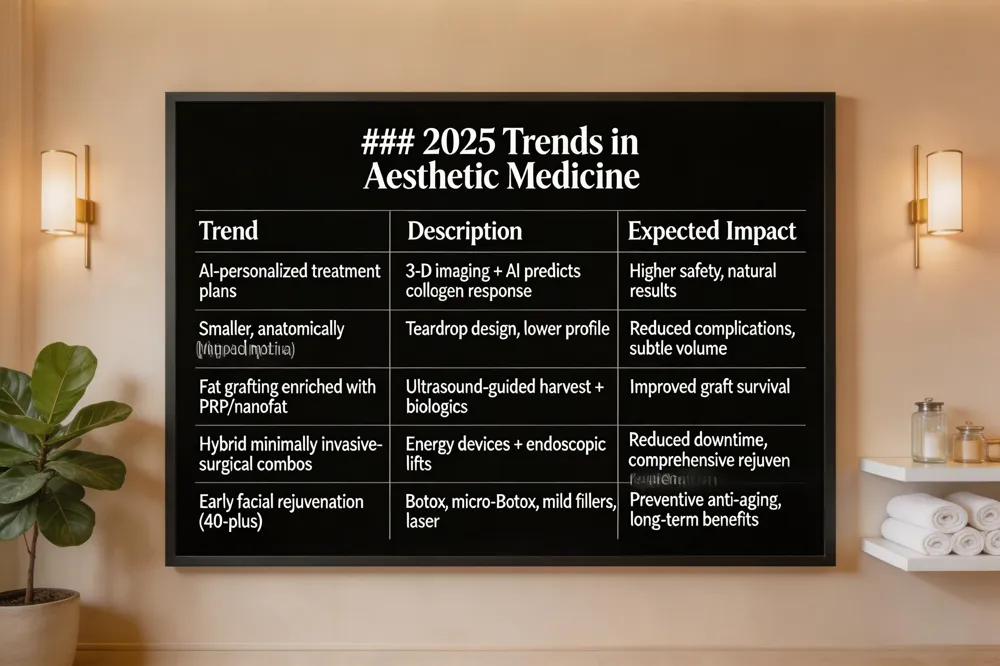 AI‑personalized treatment plans reshape 2025 aesthetics. 3‑D imaging with AI predict collagen response, letting surgeons map filler placement, RF depth and incisions. It reduces guesswork, enhances safety and yields natural results.
Smaller anatomical breast implants and autologous fat grafting dominate preferences. Motiva teardrop implants and high‑G′ hyaluronic fillers give subtle volume while lowering risk. Fat harvested with ultrasound‑guided liposuction is enriched with PRP or nanofat, improving survival.
Hybrid minimally invasive‑surgical protocols blend energy‑based devices—RF microneedling, laser resurfacing and Ultherapy—with procedures like endoscopic brow lifts or facelifts, delivering rejuvenation with reduced downtime.
Early facial rejuvenation for patients in their 40s is key. Botox, micro‑Botox, mild fillers and laser resurfacing address dynamic lines and volume loss before they become entrenched, after GLP‑1 weight loss.
What plastic‑surgery trends are expected to dominate 2025? Personalization, smaller implants, fat grafting enhanced with biologics, hybrid minimally invasive‑surgical combos, and early facial rejuvenation for 40‑plus demographic.
Where can I find the latest plastic‑surgery news and professional updates? Key sources are the ASPS website and Plastic Surgery News, the journals Plastic and Reconstructive Surgery and Aesthetic Surgery Journal, AAFPRS newsletters, and medical‑media specialty newsletters.
Continuing the Pursuit of Elegant, Safe Aesthetics
Madison Plastic Surgery epitomizes a boutique philosophy that places each client’s unique anatomy and aesthetic goals at the forefront. In a sleek New York City office, board‑certified surgeons integrate cutting‑edge minimally invasive technologies—AI‑driven 3‑D imaging, radiofrequency microneedling, advanced neuromodulators and hyaluronic fillers, and ultrasound‑guided fat‑transfer—to deliver natural, subtle enhancements with virtually no downtime. Every consultation begins with a thorough medical assessment, virtual simulation of outcomes, and a personalized treatment map that balances safety, longevity and the patient’s lifestyle. This patient‑centered approach ensures confidence‑restoring results that feel as elegant as they look. The practice’s after‑care protocol further enhances recovery and satisfaction.