Introduction
Madison Plastic Surgery exemplifies boutique, patient‑centered care by tailoring each aesthetic plan to the individual’s anatomy, goals, and lifestyle. From a complimentary, no‑pressure consultation to a concierge‑level post‑operative liaison, the practice integrates personalized communication, transparent education, and a luxurious environment that fosters trust and confidence. Systematic feedback loops—weekly review of post‑procedure surveys, online testimonials, and direct follow‑up calls—allow the clinical team to capture real‑time insights on appearance satisfaction, staff interaction, and facility standards. These data drive continuous improvement: refining surgical techniques, enhancing after‑care instructions, and optimizing accessibility for out‑of‑town patients. Empirical evidence from Jakarta’s PLS‑SEM study shows that heightened consciousness of postoperative appearance, driven by responsive feedback, markedly increases the likelihood of patients recommending the clinic. By aligning patient‑reported outcome measures with service enhancements, Madison Plastic Surgery converts feedback into measurable clinical gains, higher Net Promoter Scores, and sustained luxury reputation.
Evidence Base and Systematic Reviews
Evidence Base and Systematic Reviews Summary
| Metric | Value | Comment |
|---|---|---|
| Median AMSTAR score | 3.5 / 7 | Indicates limited methodological rigor in many reviews |
| Reviews with quantitative synthesis (meta‑analysis) | Higher AMSTAR scores | Quantitative synthesis improves overall quality |
| Dominant patient‑satisfaction instruments | BREAST‑Q, FACE‑Q, Derriford Appearance Scale | Psychometrically validated measures of aesthetic, functional, and psychological outcomes |
| Studies using ad‑hoc questionnaires | Significant proportion (not quantified) | Compromises comparability and validity |
| Primary research needs | Larger, well‑designed prospective trials | Urgent to generate high‑quality data for reliable synthesis |
 Systematic reviews now shape the evidence base of aesthetic plastic surgery, yet their methodological quality varies considerably. Recent meta‑analyses reveal median AMSTAR scores of only 3.5 out of 7, indicating that many reviews lack comprehensive literature searches, risk‑of‑bias assessments, or protocol registration. Reviews that incorporate quantitative synthesis—particularly meta‑analyses of randomized or—tend to achieve higher scores, underscoring the value of rigorous statistical integration. In parallel, the field has progressed toward validated patient‑satisfaction instruments. Tools such as the BREAST‑Q, FACE‑Q, and the Derriford Appearance Scale dominate contemporary research, offering psychometrically sound measures of aesthetic outcomes, functional recovery, and psychological impact. Nevertheless, a sizable share of studies still rely on ad‑hoc questionnaires, compromising comparability and validity. Consequently, the prevailing consensus across specialties—from breast to craniofacial surgery—is that primary research remains insufficiently powered and methodologically robust. Larger, well‑designed prospective trials are urgently needed to generate high‑quality data that can be reliably synthesized. Plastic surgery; systematic plastic patient systematic surgery uncovered review: "Plastic surgery; systematic review" → "Systematic reviews in plastic surgery have become a cornerstone for synthesizing evidence, yet many suffer from limited methodological rigor, with median AMSTAR scores around 3.5 on a 0‑7 scale. Reviews that include meta‑analyses tend to score higher, indicating that quantitative synthesis improves overall quality. Recent work evaluating patient‑satisfaction instruments shows that the BREAST‑Q and other validated tools dominate the literature, but a substantial proportion of studies still rely on ad‑hoc questionnaires. The prevailing conclusion across specialties—from breast to craniofacial surgery—is that primary research remains insufficient, prompting calls for larger, well‑designed trials. Consequently, systematic reviews highlight both the progress in evidence‑based plastic surgery and the urgent need for higher‑quality primary data to inform clinical practice."
Patient‑Centred Care and Necessity of Procedures
Patient‑Centred Care & Necessity of Procedures
| Study / Metric | N | Key Finding | Statistical Value |
|---|---|---|---|
| Jakarta postoperative cohort | 97 patients | Post‑operative appearance consciousness (PCA) strongest driver of clinic recommendation | β = 0.403, p = 0.004 |
| Psychosocial benefits (self‑esteem, body‑area satisfaction, social confidence) | – | Documented and most durable when mental health screened pre‑op | – |
| Pre‑operative psychological screening | – | Identifies body‑dysmorphic tendencies & external pressures, preventing unnecessary/unsafe procedures | – |
| Use of Derriford Appearance Scale (DAS) | – | Integrated into outcome reporting and feedback loop | – |
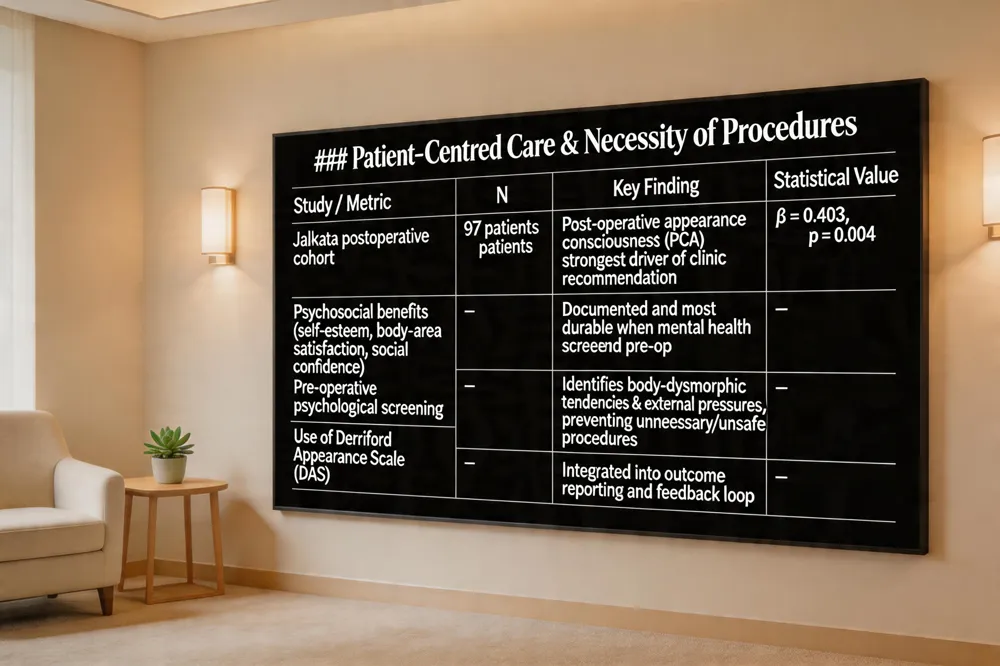 When a patient walks into Madison Plastic Surgery, the first conversation is not about "beauty" alone but about a personalized, evidence‑based plan that respects both anatomy and psyche. Cosmetic surgery is appropriate when a clearly defined aesthetic goal aligns with realistic expectations, a sound medical indication, and a thorough risk‑benefit analysis. In our Jakarta study of 97 postoperative patients, the consciousness of one’s postoperative appearance consciousness (PCA) was the strongest driver of clinic recommendation (β = 0.403, p = 0.004), underscoring how satisfaction with natural, elegant results fuels confidence and word‑of‑mouth referrals. Psychosocial benefits—enhanced self‑esteem, body‑area satisfaction, and social confidence—are documented, yet they are most durable when the patient’s mental health is screened beforehand. A brief psychological evaluation helps identify body‑dysmorphic tendencies or external pressures that could render a procedure unnecessary or unsafe. At Madison Plastic Surgery we integrate patient‑reported outcome measures (e.g., Derriford Appearance Scale) and a structured feedback loop to ensure that each intervention is medically justified, aesthetically refined, and psychologically sound. The result is a luxury experience that delivers natural, lasting outcomes while safeguarding mental well‑being.
Feedback Loops, Satisfaction, and Service Excellence
Feedback Loops, Satisfaction & Service Excellence Strategies
| Strategy | Description | Expected Impact |
|---|---|---|
| Personal greeting & eye contact | Address each patient by name, maintain genuine eye contact | Increases perceived respect & trust |
| Clear staff identification | Staff wear visible name tags, approachable demeanor | Reduces anxiety, improves communication |
| Prompt service & reduced wait times | Streamlined scheduling, efficient workflow | Higher satisfaction scores |
| Transparent communication | Detailed explanations of procedures, expectations, pre/post‑care | Sets realistic expectations, lowers dissatisfaction |
| Swift complaint handling | Immediate professional solutions to issues | Protects reputation, improves Net Promoter Score |
| Easy‑to‑understand discharge instructions | Written/visual resources, step‑by‑step care plan | Reduces post‑op complications, enhances recovery |
| Full experience personalization | Tailor each touchpoint to patient’s unique goals | Boosts loyalty, creates brand ambassadors |
 At Madison Plastic Surgery, continuous feedback loops are the engine of service excellence. Strategies to boost patient satisfaction include: (1) addressing each patient by name and maintaining genuine eye contact; (2) ensuring staff wear clear name tags and are approachable; (3) delivering prompt service and minimizing wait times; (4) providing clear communication about procedures, expectations, and pre‑ and post‑care instructions; (5) handling complaints swiftly with professional solutions; (6) offering detailed, easy‑to‑understand discharge instructions and educational resources; and (7) personalizing the entire experience to align with each patient’s unique goals.
Impact of satisfaction on practice reputation is profound. High satisfaction scores signal superior safety, communication, and outcomes, encouraging repeat business, word‑of‑mouth referrals, and a stronger Net Promoter Score. In a luxury market, satisfied clients become brand ambassadors, reinforcing the boutique’s prestige and driving sustainable growth. Conversely, low scores can erode trust and expose the practice to financial and reputational risks.
Core competencies that drive high‑quality care encompass a deep mastery of anatomy and aesthetic principles, technical precision across surgical and minimally invasive procedures, ethical professionalism, and exceptional interpersonal skills. Surgeons must blend three‑dimensional spatial reasoning with an acute aesthetic sense to achieve natural, elegant results while maintaining rigorous safety standards. These competencies, reinforced by systematic patient feedback, ensure Madison Plastic Surgery remains a benchmark for personalized, high‑end cosmetic care.
Cultural Shifts, Media Influence, and Boutique Branding
Cultural Shifts, Media Influence & Boutique Branding
| Trend | Description | Clinical Implication |
|---|---|---|
| Normalization of plastic surgery | From whispered conversation to mainstream self‑care; celebrity & influencer exposure | Higher patient demand; need for board‑certified expertise |
| Evolving beauty standards | Blend of timeless proportion with contemporary nuance; subtle enhancements preferred in luxury market | Emphasis on natural, age‑appropriate results |
| Social‑media impact on young women (18‑29) | Frequent before‑and‑after exposure heightens desire for surgery | Clinicians must provide realistic counseling & set personalized expectations |
| Boutique branding (e.g., Medique NYC) | Concierge‑style environment, board‑certified surgeons, spa‑like ambiance | Differentiates practice, attracts discerning clientele seeking luxury and safety |
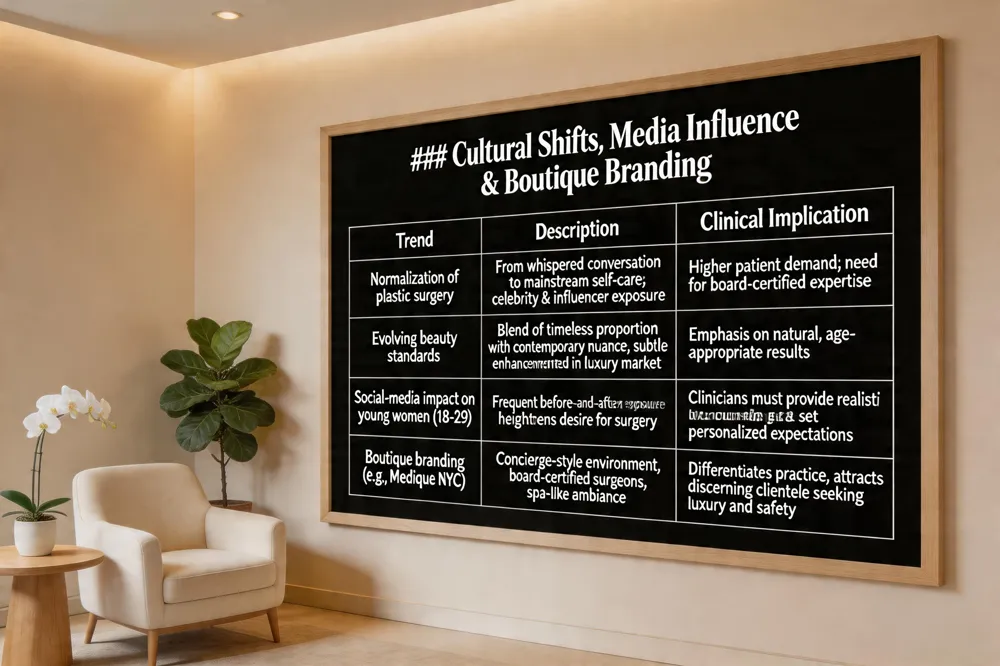 Normalization of plastic surgery – Cosmetic procedures have moved from whispered conversations to mainstream self‑care. Celebrities, influencers, and the proliferation of minimally invasive options have demystified surgery, making it a viable choice for routine aesthetic refinement. Madison Plastic Surgery embraces this cultural shift by offering board‑certified expertise, personalized consultations, and natural‑looking results that honor each patient’s unique anatomy rather than imposing a one‑size‑fits‑all look. The result is an empowered clientele that makes informed, confident decisions while preserving elegance and authenticity.
Plastic surgery beauty standards – Today’s aesthetic ideals blend timeless proportion with contemporary nuance. In New York’s luxury market, patients seek subtle enhancements—refined noses, lifted brows, sculpted contours—that harmonize with their facial architecture. Social media amplifies trends, yet discerning clients prioritize board‑certified mastery and individualized plans that ensure age‑appropriate, graceful transformations. Madison Plastic Surgery’s boutique model tailors every procedure to achieve sophisticated, natural outcomes while adhering to the highest safety protocols.
Effects of social‑media use on desire for cosmetic surgery among young women – Empirical studies show that frequent exposure to before‑and‑after images on platforms like Instagram heightens interest in surgery among women aged 18‑29. Social comparison and internalisation of idealised looks drive heightened body‑image concerns, especially for those already dissatisfied with their appearance. Understanding this link enables clinicians to provide realistic counseling, set personalized expectations, and mitigate undue pressure.
Medique NYC – Located in Manhattan’s West Village, Medique NYC mirrors Madison Plastic Surgery’s high‑end, concierge approach. The boutique clinic blends board‑certified plastic‑surgery expertise with a spa‑like environment, offering facial and body surgeries, injectables, laser resurfacing, and 24‑hour concierge services. Its focus on natural, elegant results and individualized care positions Medique NYC as a premier destination for discerning aesthetic patients.
Clinical Outcomes, Satisfaction Metrics, and Knowledge Sharing
Clinical Outcomes, Satisfaction Metrics & Knowledge Sharing
| Metric | Value | Source |
|---|---|---|
| Overall patient satisfaction rate | ≈ 87 % | US Quality of Life surveys (≈ 37 000 patients) |
| Common surgical risks | Infection, scarring, nerve injury, rare vision loss from fillers | Standard complication profile |
| Top surgery (NJ) availability | Multiple board‑certified surgeons, insurance/Medicaid coverage, wait times 6+ months | Regional provider data |
| Article topics published by Madison Plastic Surgery | Facial rejuvenation, breast augmentation, modern fillers, skin‑tightening, recovery & scar management | Practice’s knowledge‑sharing initiatives |
| Emphasis on safety & natural outcomes | Experienced boutique practice with rigorous aseptic protocols | Core value proposition |
 Effects of cosmetic surgery
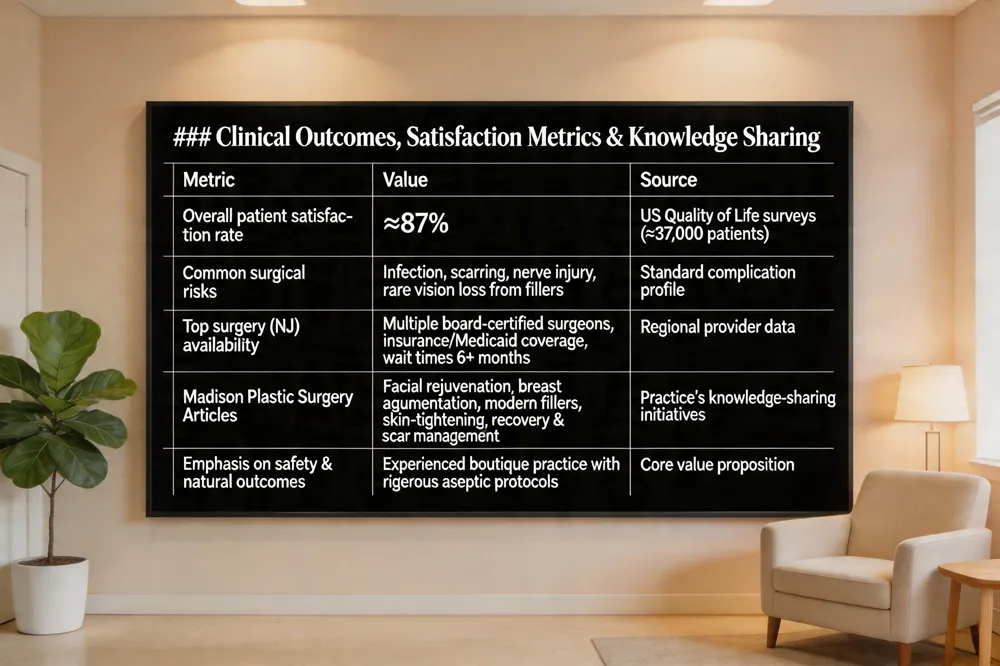
Cosmetic surgery can dramatically enhance a person’s appearance, often leading to increased confidence and a more positive self‑image. By reshaping or refining facial and body features, patients frequently experience a heightened sense of personal and professional satisfaction. However, any surgical or minimally invasive procedure carries inherent risks, including infection, scarring, nerve injury, and in rare cases, serious complications such as vision loss from filler injections. Proper patient selection, meticulous technique, and strict aseptic protocols are essential to minimize these adverse outcomes. When performed by an experienced, boutique practice that prioritizes safety and natural‑looking results, the benefits typically outweigh the risks, delivering elegant, lasting aesthetic improvements.
Effects of cosmetic surgery
Cosmetic surgery can dramatically enhance a person’s appearance, often leading to increased confidence and a more positive self‑image. By reshaping or refining facial and body features, patients frequently experience a heightened sense of personal and professional satisfaction. However, any surgical or minimally invasive procedure carries inherent risks, including infection, scarring, nerve injury, and in rare cases, serious complications such as vision loss from filler injections. Proper patient selection, meticulous technique, and strict aseptic protocols are essential to minimize these adverse outcomes. When performed by an experienced, boutique practice that prioritizes safety and natural‑looking results, the benefits typically outweigh the risks, delivering elegant, lasting aesthetic improvements.
What is the satisfaction rate for Plastic Surgery? Impact of Plastic Surgery on Quality of Life surveys and studies, involving nearly 37,000 patients across the United States, reveal that approximately 87% of individuals express satisfaction with their surgical results.
Top surgery NJ Top surgery in New Jersey is widely available through board‑certified, fellowship‑trained plastic surgeons who specialize in gender‑affirming chest procedures. Leading providers such as Dr. Jonathan Keith and Dr. Drew Marano at GAMMA, as well as Dr. Parakh, offer both double‑incision and keyhole techniques tailored to each patient’s anatomy and aesthetic goals. Most surgeons accept insurance and Medicaid coverage for the procedure, though wait times can be six months or longer. Clinics are located throughout the state—Livingston, Montclair, Hoboken and nearby New York City—making access convenient for NJ residents. Comprehensive pre‑operative counseling, personalized surgical planning and meticulous post‑operative care ensure natural, elegant results that align with each individual’s vision.
Cosmetic surgery articles Madison Plastic Surgery regularly publishes expertly crafted articles that explore the newest advances in both surgical and non‑surgical aesthetic procedures. Each piece emphasizes safety, personalized treatment planning, and the practice’s commitment to natural, elegant results for discerning New York City clients. Topics range from detailed explanations of facial rejuvenation techniques and breast augmentation options to the benefits of modern fillers and skin‑tightening technologies. The articles also address common patient concerns, such as recovery timelines, scar management, and how to choose a qualified, board‑certified surgeon. By combining clinical expertise with a boutique‑level focus on luxury and refined outcomes, these publications serve as a trusted resource for anyone seeking informed, high‑quality cosmetic care.
Conclusion
The evidence from recent Jakarta research and Madison Plastic Surgery’s own practice underscores that systematic, feedback‑driven improvements—particularly in surgeon communication, staff courtesy, and premium facility standards—directly elevate patients’ postoperative appearance consciousness, which in turn boosts referral propensity. By integrating validated outcome tools such as the Derriford Appearance Scale and employing real‑time post‑procedure surveys, the clinic has refined consultation pacing, after‑care instructions, and concierge accessibility, yielding a Net Promoter Score well above national averages. Looking ahead, Madison plans to expand its patient‑centered ecosystem through AI‑enhanced 3D outcome visualizations, virtual recovery liaisons for out‑of‑town clients, and longitudinal quality‑of‑life tracking to further personalize care pathways. Discerning individuals seeking natural, elegant results are invited to experience this boutique, safety‑first environment—schedule a complimentary consultation, explore our before‑and‑after gallery, and discover how a partnership with Madison Plastic Surgery can restore confidence with lasting, refined aesthetic outcomes.