A Boutique Approach to Natural‑Looking Breast Augmentation
At the heart of a boutique practice is a patient‑centered aesthetic philosophy that treats each breast as a unique work of art. Before any incision, the surgeon conducts a thorough consultation, using 3‑D imaging and precise measurements to capture the individual’s frame, shoulder width, skin elasticity, and desired silhouette. This personalized blueprint allows the surgeon to balance volume with proportion, selecting the smallest implant or the most modest fat‑transfer volume that achieves harmony rather than dominance. Modern techniques—low‑profile silicone or saline implants, teardrop‑shaped “gummy‑bear” gel, submuscular or subglandular placement, and autologous fat grafting—are matched to the patient’s anatomy and lifestyle, ensuring a soft, natural feel and a seamless transition from chest wall to breast tissue. Madison Plastic Surgery embraces this ethos: board‑certified surgeons combine advanced imaging, meticulous incision planning, and a collaborative decision‑making process to deliver elegant, understated results. The practice’s boutique setting emphasizes safety, luxury, and rigorous after‑care, allowing patients to regain confidence with a breast augmentation that looks, feels, and ages naturally.
Non‑Surgical and Minimal‑Invasive Options
 Natural breast enhancement without surgery
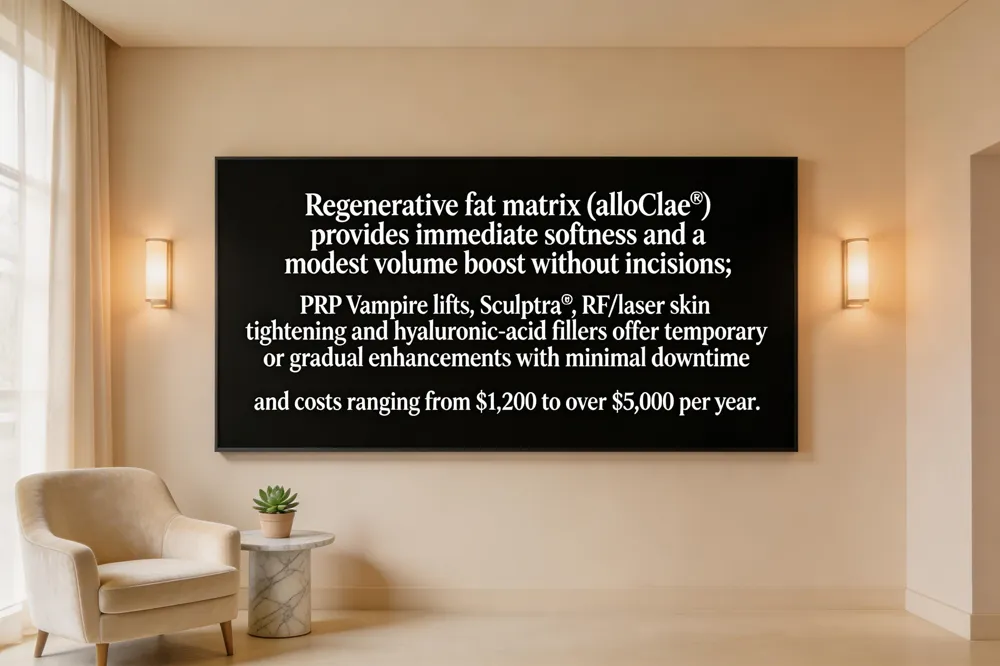
For patients who desire a subtle lift without incisions, the leading option is a regenerative fat matrix such as alloClae®. This FDA‑registered, ready‑to‑use injectable contains live adipose cells and growth factors that integrate with native tissue, delivering immediate softness and a modest volume increase of half to one‑and‑a‑half cup sizes. Because it requires no liposuction, anesthesia, or permanent foreign material, recovery is virtually painless and daily activities can resume immediately.
Non‑surgical breast augmentation cost
Pricing varies by technology. PRP‑based “Vampire” lifts range from $1,200‑$4,500, thread‑lifts average $2,250, radio‑frequency or laser skin‑tightening $1,144‑$2,071 per session, and a Thermage treatment about $1,800. Multiple sessions are often needed, so total investment can exceed $5,000‑$10,000 over a year. Madison Plastic Surgery tailors a personalized plan that aligns aesthetic goals with the premium boutique experience.
Vampire Breast Lift
A Vampire Lift uses autologous platelet‑rich plasma to stimulate collagen production, providing a gentle, temporary improvement in texture and firmness. The procedure is minimally invasive, with a short recovery, but results are subtle and short‑lived; it is best used as a complementary treatment rather than a standalone surgical lift.
Non‑surgical breast enhancement – Sculptra®
Sculptra® (poly‑L‑lactic acid) induces gradual collagen remodeling, offering a natural‑looking lift and 1‑2‑cup volume increase over several months. The treatment requires minimal downtime and can be customized to each patient’s anatomy for elegant, lasting results.
Non‑surgical breast lift before and after
Radio‑frequency or laser‑based lifts tighten skin and improve pole fullness without incisions. Patients typically notice higher, rounder breasts immediately, with continued collagen‑mediated refinement over weeks. Recovery is minimal; most return to normal activities the same day.
Non‑surgical breast enhancement near me
Madison Plastic Surgery in New York City provides all of the above technologies—including hyaluronic‑acid fillers, PRP, and Sculptra—in a private, boutique setting. Complimentary consultations assess anatomy and goals, ensuring a customized, natural‑looking plan.
Breast enlargement injection price
Injectable filler augmentation ranges from $800‑$3,500 depending on product and volume. Autologous fat‑transfer “enlargement injection” averages $5,700, encompassing surgeon fees, anesthesia, and facility costs. Financing options are available to align with each patient’s investment preferences.
Implant‑Based Subtle Augmentation
 Mini breast implants before and after – Mini implants (100‑250 cc) add roughly one cup size, transforming a deflated or asymmetrical breast into a fuller, balanced silhouette. Recovery is swift, and the low‑profile shape preserves an athletic look.
Most natural‑looking breast implants – Form‑stable “gummy‑bear” silicone implants retain a teardrop shape and, when placed submuscular, blend seamlessly with tissue, offering a soft, natural feel and minimal rippling.
Ballerina breast augmentation – This “mini‑boob” approach uses small, anatomically‑shaped implants or autologous fat transfer to achieve a light, perky lift that moves freely during dance or sport.
Yoga breast implants – Low‑profile silicone or saline implants (≤150 cc) provide modest volume without compromising flexibility, allowing patients to resume yoga poses within 4‑6 weeks.
Low profile ballerina breast implants – 150‑300 cc low‑ or moderate‑profile implants create a gentle slope, reducing shoulder strain and enhancing elegance for petite or athletic frames.
Gummy bear implants – Ultra‑cohesive silicone implants maintain shape, resist rippling, and mimic natural breast density, ideal for patients seeking a refined, durable result.
Smooth breast implants – Smooth shells move naturally within the pocket, offering a lifelike motion and low BIA‑ALCL risk, though careful technique is needed to minimize capsular contracture.
Breast implants side effects & risks – Common issues include capsular contracture, rippling, nipple sensation changes, and rare complications such as rupture, BIA‑ALCL, or systemic symptoms. Regular imaging and board‑certified surgeon follow‑up ensure safety and longevity.
Hybrid and Fat‑Transfer Techniques
 Autologous fat grafting (fat transfer) harvests excess adipose tissue via liposuction from donor sites such as the abdomen, thighs, flanks or hips, purifies it, and injects it in thin layers into the breast. The technique yields a soft, organic feel, simultaneous body contouring, and eliminates implant‑related risks like capsular contracture. Hybrid augmentation pairs a modest silicone implant—often a low‑profile or teardrop‑shaped device—with targeted fat grafts to smooth implant edges, add upper‑pole fullness, and achieve a seamless, natural contour, especially for patients with thin chest walls.
Donor‑site selection focuses on areas with sufficient, stable fat; the abdomen and thighs are most common. Multi‑plane injection (deep, middle, superficial) and gentle low‑speed processing maximize graft take, with 50‑70 % of transferred fat typically surviving after six months. Ideal candidates are healthy, non‑smokers with stable weight and realistic expectations for modest volume (≈½‑1 cup size). Limitations include limited volume increase, potential resorption, and inability to correct significant ptosis without a lift.
Fat transfer breast augmentation: Uses liposuction‑harvested autologous fat to modestly increase breast volume, offering a natural feel and minimal scarring. About 30 % of grafted fat may reabsorb; a follow‑up session can fine‑tune results.
Natural breast augmentation cost: Generally $7,000‑$17,500, with boutique NYC practices often exceeding $12,000 after facility and anesthesia fees.
Ballerina breast augmentation cost**: Subtle lift with small implants ranges $9,000‑$13,000 in New York City, excluding additional lift or revision work.
Breast augmentation surgery cost at Madison Plastic Surgery: $6,000‑$20,000+ depending on implant type, surgeon expertise, and facility.
Hybrid breast augmentation: Combines a small silicone implant with autologous fat grafting to enhance softness and contour, tailored to each patient’s anatomy for a natural, elegant result.
Surgical Planning, Personalization, and Cutting‑Edge Techniques
 Advanced 3‑D imaging and Vectra simulation allow board‑certified surgeons to map each patient’s chest wall, breast base width, and tissue quality before a scalpel is touched. By visualizing a range of implant sizes, shapes, profiles and surfaces, the surgeon can recommend the most subtle augmentation—often a low‑profile silicone or “gummy‑bear” gel implant of 150‑200 cc that adds half a cup and mimics native tissue.
Implant selection is tailored to anatomy: cohesive silicone for softness, teardrop‑shaped form‑stable implants for a natural slope, and smooth surfaces to reduce rippling. Placement planes are chosen to balance coverage and feel—submuscular for maximal muscle coverage and a smooth upper‑chest contour, subglandular for a softer touch, dual‑plane for athletic patients, and subfascial with acellular dermal matrix (ADM) acting as an internal bra.
Emerging methods such as the Preservé™ technique and next‑generation Motiva® implants further preserve nipple sensation, limit scarring, and lower capsular‑contracture risk. Hybrid approaches combine a modest implant with autologous fat grafting to smooth edges and add upper‑pole fullness.
Recovery follows a predictable timeline: light activities resume within 1‑2 weeks, full workouts by 4‑6 weeks, and final contour refinement visible at 3‑6 months. Meticulous postoperative care—including compression garments, scar‑management, and scheduled follow‑ups—ensures lasting, elegant results that align with the boutique, safety‑first philosophy of Madison Plastic Surgery.
Safety, Risks, and Patient Considerations
 Modern breast augmentation balances aesthetic elegance with rigorous safety protocols. Capsular contracture, implant rippling, and animation deformity remain the most common tissue‑related complications; submuscular placement of silicone or gummy‑bear implants often mitigates these issues by providing greater muscle coverage and a smoother upper‑chest contour. Implant‑associated anaplastic large‑cell lymphoma (BIA‑ALCL) is linked primarily to textured‑surface devices, prompting most surgeons to favor smooth‑surface silicone or cohesive gel implants and to adhere to FDA‑recommended imaging schedules—MRI or ultrasound at five‑to‑six years post‑op and every two to three years thereafter—to detect silent rupture or early signs of disease.
Weight fluctuations, smoking, and donor‑site health critically influence outcomes. Significant weight loss can accentuate rippling, especially with low‑profile implants, while smoking impairs wound healing and increases capsular contracture risk. Autologous fat transfer eliminates foreign‑body concerns but carries variable graft survival (50‑70 % at six months) and requires careful donor‑site assessment.
Long‑term monitoring includes regular clinical exams, imaging, and transparent patient education. Informed consent should cover potential side effects—from localized pain and sensation changes to rare systemic implant illness—ensuring patients make confident, personalized decisions aligned with their lifestyle and aesthetic goals.
Elevating Beauty with Subtlety and Precision
At Madison Plastic Surgery, every patient is welcomed into a boutique environment where personalized care is the cornerstone of the experience. Our board‑certified surgeons begin each journey with an in‑depth consultation, employing 3‑D imaging and Vectra simulation to map the patient’s unique anatomy, aesthetic goals, and lifestyle. This data‑driven approach ensures that the selected implant—whether a low‑profile silicone, a teardrop‑shaped “gummy bear,” or a modest saline— or fat‑transfer graft is harmoniously proportioned to the chest wall, breast base width, and upper‑to‑lower pole ratio identified by Dr. Patrick Mallucci as the hallmark of a natural breast.
The commitment to natural, elegant outcomes drives every technical decision: submuscular or dual‑plane placement maximizes tissue coverage for thin‑skinned patients, while subglandular placement preserves a soft feel when native tissue is ample. Hybrid augmentations blend a small implant with autologous fat to camouflage edges and enhance upper‑pole fullness, delivering a seamless contour that moves with the body. All procedures are performed in accredited facilities with meticulous sterility protocols, and postoperative care includes personalized compression garments and a structured activity timeline to promote swift healing.
Your next step is simple—schedule a private consultation to explore how our refined, evidence‑based techniques can restore confidence through a subtle, lasting transformation.