Blending Art and Precision in Modern Aesthetics
Plastic surgery today fuses artistic vision with cutting‑edge science, creating a dynamic field where precision tools—microsurgery, 3‑D imaging, robotic assistance—meet the surgeon’s aesthetic eye. Board‑certified experts personalize each plan, using advanced simulations to set realistic expectations while adhering to strict safety protocols in accredited facilities. The result is natural‑looking, elegant enhancement that restores confidence and aligns with each patient’s unique anatomy and long‑term satisfaction through meticulous after‑care and follow‑up programs.
Global Landscape and Market Trends
Top 10 Plastic‑Surgery Countries (ISAPS 2023)
| Rank | Country | Approx. Annual Procedural Volume |
|---|---|---|
| 1 | United States | 6.1 million (≈ 16% of world) |
| 2 | Brazil | 1.5 million |
| 3 | South Korea | 1.3 million |
| 4 | Mexico | 0.9 million |
| 5 | Turkey | 0.8 million |
| 6 | Colombia | 0.6 million |
| 7 | Thailand | 0.5 million |
| 8 | Germany | 0.4 million |
| 9 | Japan | 0.4 million |
| 10 | Italy | 0.3 million |
Global Aesthetic Procedure Volume (ISAPS 2024)
| Category | Total Procedures |
|---|---|
| Surgical | 17.4 million |
| Non‑surgical | 20.5 million |
| Overall | 38 million |
Eyelid surgery – 2.1 million (largest surgical subgroup) Botulinum‑toxin – 7.8 million injections (largest non‑surgical subgroup)
U.S. State with Highest Per‑Capita Surgeon Density
| State | Surgeons per 10 000 Residents |
|---|---|
| Florida | 0.220 |
| New York | 0.217 |
Cosmetic‑Surgery Tourism (2023)
| Destination | Inbound Patients (millions) |
|---|---|
| Brazil | 0.35 |
| Turkey | 0.30 |
| South Korea | 0.25 |
| Tunisia | 0.12 (high foreign‑patient share) |
| UAE | 0.10 (high foreign‑patient share) |
| Colombia | 0.08 (high foreign‑patient share) |
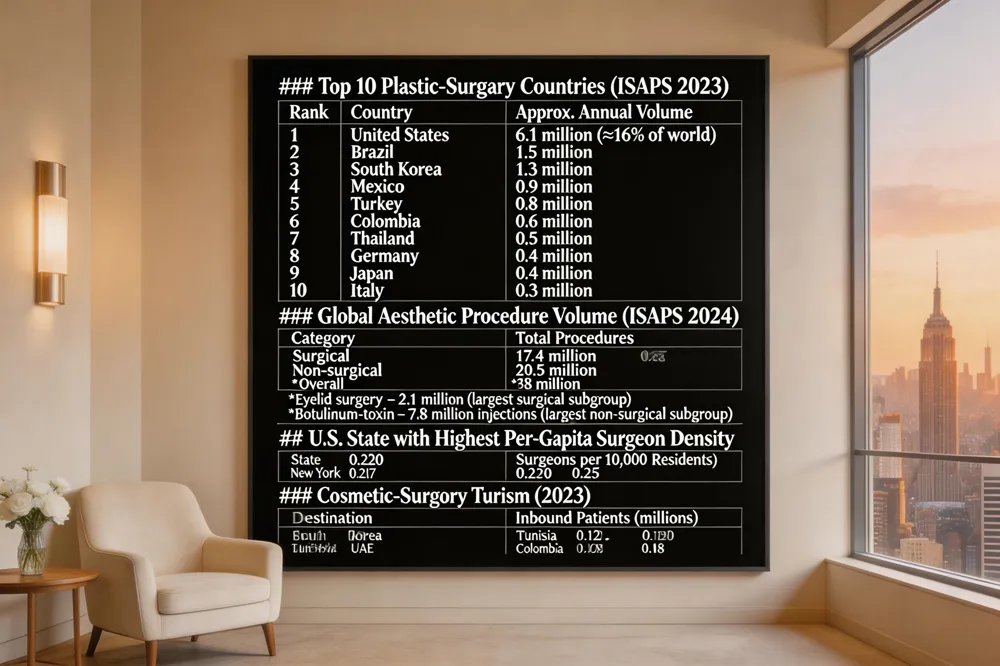 Top 10 plastic surgery countries – According to ISAPS 2023, the United States, Brazil, South Korea, Mexico, Turkey, Colombia, Thailand, Germany, Japan and Italy lead in procedural volume. Emerging hubs like Dubai and Iran appear, yet the core leaders—U.S., Brazil, South Korea—still dominate with board‑certified expertise.
Plastic surgery statistics worldwide – ISAPS 2024 reports 38 million aesthetic procedures globally (17.4 million surgical, 20.5 million non‑surgical). Eyelid surgery topped surgical counts, while botulinum‑toxin injections led non‑surgical volume. Over 6 million procedures occurred in the United States, the highest national total.
Which US state has the highest per‑capita plastic surgery rate? – Florida leads with 0.220 surgeons per 10 000 residents, slightly ahead of New York (0.217). This concentration reflects strong patient demand and surgeon supply.
Cosmetic surgery tourism statistics – In 2023, 1.2 million patients traveled abroad; Brazil, Turkey and South Korea dominate inbound flows, while Tunisia, UAE and Colombia record the highest foreign‑patient shares.
Where is plastic surgery most common? – South Korea has the highest per‑capita rate (≈ 1 in 5 women), whereas United States performs the greatest absolute number of surgeries in California, New York and Florida.
Madison Plastic Surgery: A Boutique Model of Excellence
Madison Plastic Surgery – Core Offerings
| Service Category | Specific Procedures / Technologies | Distinctive Features |
|---|---|---|
| Surgical | Rhinoplasty, Facelift, Breast Augmentation, High‑Definition Liposuction, Autologous Fat Transfer | 3‑D imaging, board‑certified surgeon (Dr. Robert Tornambe), AAAASF‑accredited facility |
| Non‑Surgical | Botox, Dermal Fillers, Laser Resurfacing, PRP, Regenerative Therapies | Concierge consultation, personalized goal‑setting, minimal‑downtime protocols |
| Safety & Quality | Pre‑operative medical screening, board‑certified anesthesiologists, strict aseptic protocols, post‑op follow‑up | Comprehensive risk assessment, 24/7 patient support |
| Patient Experience | Private treatment rooms, tailored recovery plans, digital post‑op education portal | Luxury concierge service, transparent communication |
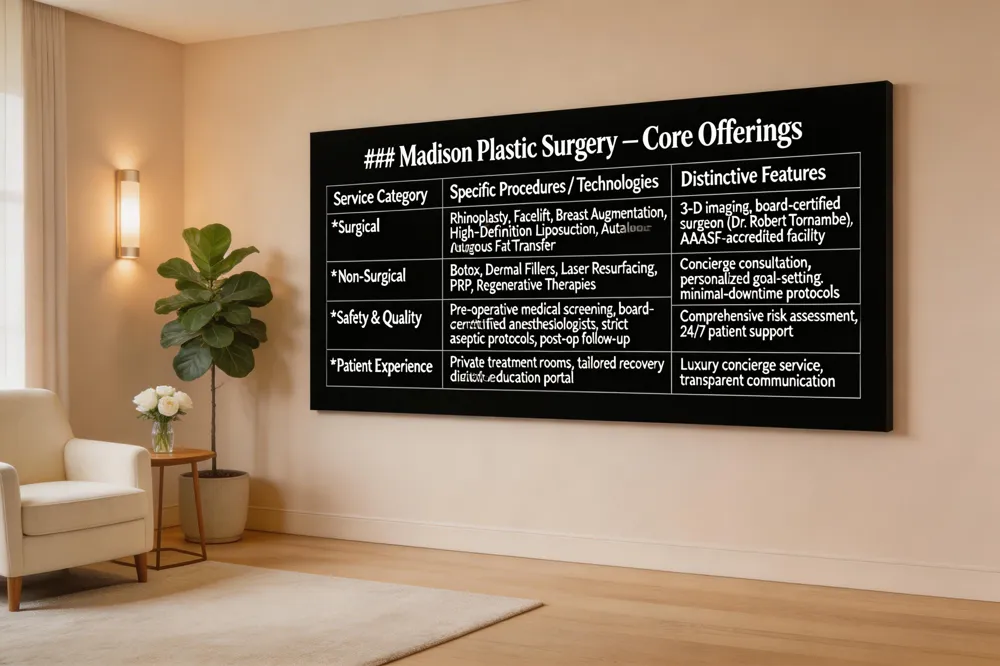 Located on Manhattan’s Upper East Side at 46 E 82nd St, Madison Plastic Surgery offers a luxury, concierge experience led by board‑certified surgeon Dr. Robert Tornambe, MD. Dr. Tornambe’s extensive residency, fellowship training, and over 45 years of practice ensure mastery of both reconstructive and cosmetic techniques, from rhinoplasty and facelifts to high‑definition liposuction and breast augmentation. The practice’s service spectrum includes surgical and non‑surgical options—injectables, laser resurfacing, and regenerative therapies—each tailored through meticulous 3‑D imaging and personalized goal‑setting. Patient safety is paramount: pre‑operative medical screening, AAAASF‑accredited facilities, board‑certified anesthesiologists, and strict aseptic protocols minimize complications, while post‑operative follow‑up and education optimize long‑term results. Selecting a high‑quality surgeon involves confirming board certification, reviewing procedural volume and before‑and‑after portfolios, and gauging communication style during a pressure‑free consultation. Madison Plastic Surgery exemplifies these standards, delivering natural, elegant outcomes that restore confidence while upholding the highest safety and artistic benchmarks.
Procedure‑Specific Outcomes and Emerging Trends
Key Outcome Metrics (2024‑2025)
| Metric | Value / Trend |
|---|---|
| Blepharoplasty regret (any dissatisfaction) | 5‑10 % (first year) |
| Severe regret (requiring revision) | < 5 % of dissatisfied patients |
| Most popular procedures (2025) | Breast augmentation, Liposuction, Rhinoplasty, Botox |
| Emerging surgical trend | Deep‑plane facelifts (W‑Lift), Autologous fat‑transfer |
| BBL popularity (2026) | Still high; rebranded as “fat grafting to the buttocks”, emphasis on safety & modest contour |
| Global aesthetic volume (2024) | 38 million procedures (US > 6.1 million) |
| Leading surgical subgroup | Eyelid surgery – 2.1 million |
| Leading non‑surgical subgroup | Botox – 7.8 million injections |
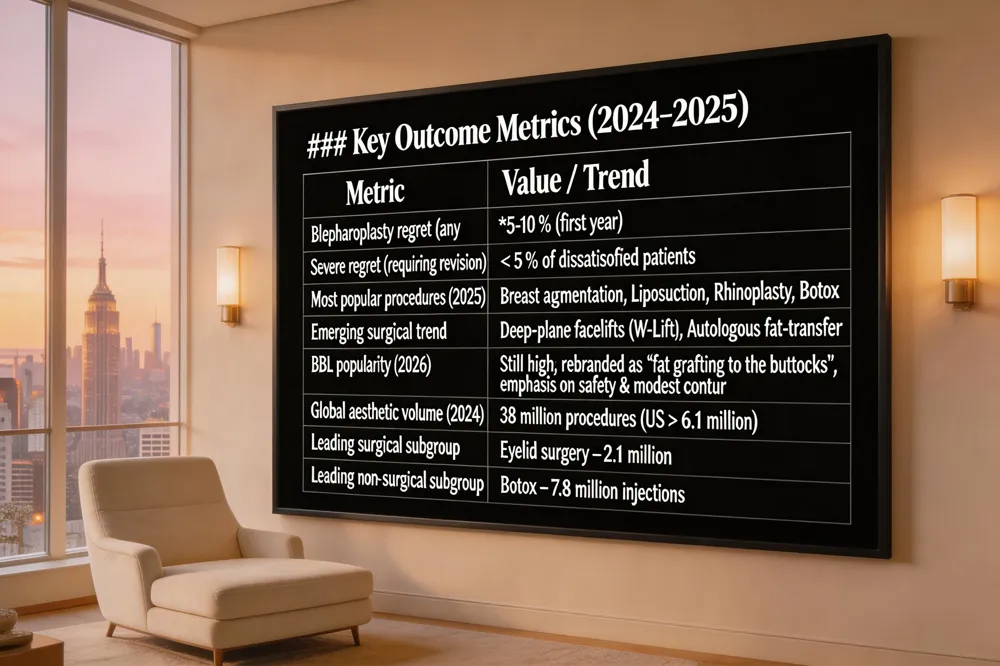 What is the regret rate for blepharoplasty? A large 2024 study in the Aesthetic Surgery Journal reported 5‑10 % of patients expressing some dissatisfaction within the first year, primarily mild swelling or slight asymmetry. Severe regret—feeling the surgery made them look older or requiring revision—occurs in under 5 % of those dissatisfied. Selecting a board‑certified surgeon at a boutique practice like Madison Plastic Surgery keeps regret at the lower end of this range.
Are BBLs out of style in 2026? No. BBLs remain popular but are rebranded as “fat grafting to the buttocks,” emphasizing safety and natural shape. Trends favor modest, proportion‑focused contouring and “skinny BBLs,” with some patients opting for BBL reduction for balance.
Most popular plastic surgery 2025: Breast augmentation, liposuction, rhinoplasty, and injectable Botox top the list. Deep‑plane facelifts (e.g., W‑Lift) and autologous fat‑transfer procedures are gaining traction for subtle, personalized rejuvenation.
Plastic surgery statistics 2024: Over 38 million aesthetic procedures globally; the U.S. performed >6.1 million. Eyelid surgery led surgical volume (2.1 million), while Botox remained the most common non‑surgical treatment (7.8 million injections).
Negative effects of plastic surgery on mental health: Unrealistic expectations can trigger anxiety, depression, or body‑dysmorphic disorder, especially in socially‑media‑driven patients. Pre‑operative psychological screening and thorough counseling are essential to mitigate these risks.
The Art and Science of Plastic Surgery
Artistic vs. Scientific Elements
| Aspect | Artistic Component | Scientific Component |
|---|---|---|
| Vision | Symmetry, proportion, aesthetic balance | Anatomical studies, facial‑body ratios |
| Planning | 3‑D simulation, patient‑centered design | Precise measurements, imaging software, CAD/CAM |
| Technique | Sculpting, tissue handling, artistic judgment | Millimeter‑accurate incisions, device technology, robotic assistance |
| Safety | Compassionate communication, expectation management | AAAASF accreditation, ASPS/FDA standards, intra‑operative monitoring |
| Outcome Evaluation | Visual harmony, patient satisfaction | Quantitative metrics (complication rates, scar scales) |
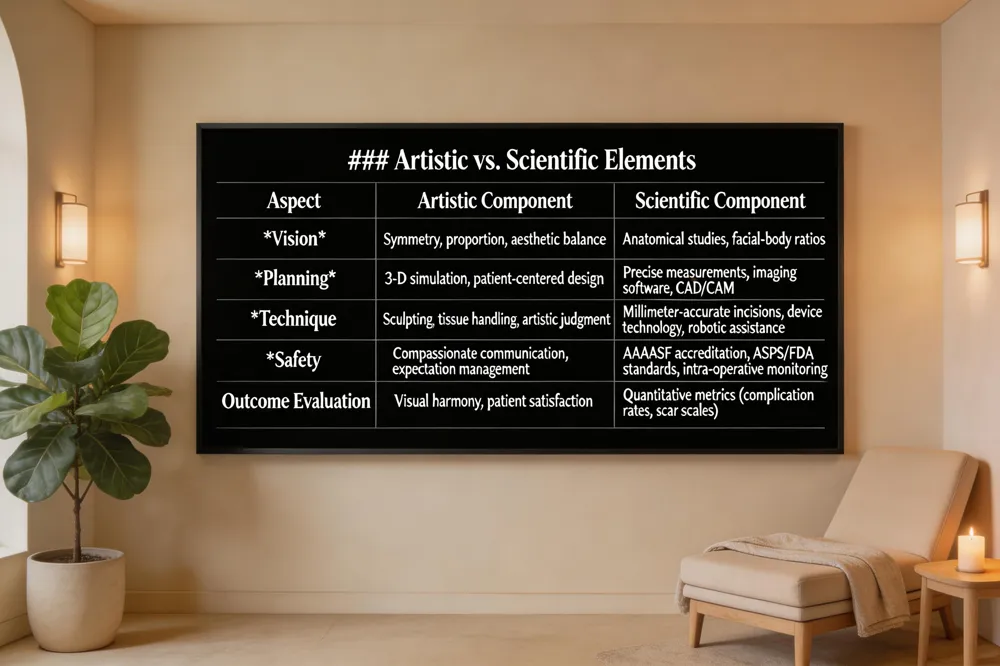 Plastic surgery thrives at the intersection of artistic vision and scientific precision. Board‑certified surgeons blend an eye for symmetry, proportion, and balance with millimeter‑accurate techniques—whether sculpting a nose, contouring the torso, or performing a facelift. Modern practices such as Madison Plastic Surgery leverage advanced imaging, 3‑D simulation, and robotic‑assisted tools to translate a patient’s aesthetic goals into a detailed surgical roadmap, allowing both surgeon and patient to preview outcomes before an incision is made. Safety is anchored in rigorous standards: surgeons complete extensive accredited residencies, operate in AAAASF‑accredited facilities, and adhere to ASPS and FDA regulations for devices and implants. Comprehensive pre‑operative assessments, meticulous intra‑operative technique, and structured postoperative follow‑up—including scar management, compression garments, and lifestyle counseling—ensure low complication rates and durable results. The ultimate aim is a natural, elegant transformation, achieved through individualized treatment planning, precise tissue handling, and a concierge‑level care model that prioritizes confidence restoration and long‑term patient satisfaction.
Patient‑Centred Care and Long‑Term Outcomes
Long‑Term Outcome Indicators
| Indicator | Typical Improvement Post‑Surgery |
|---|---|
| Body satisfaction | +20 % to +35 % (short‑term) |
| Self‑esteem | +15 % to +30 % (up to 6 months) |
| Sexual well‑being | +10 % to +25 % |
| Quality‑of‑life score (SF‑36) | +0.5 to +1.2 points (6 months) |
| Depressive symptom reduction | 10 %–20 % decrease (PHQ‑9) |
| Regret rate (overall) | < 5 % when thorough pre‑op counseling is performed |
Key drivers of sustained satisfaction: 3‑D imaging preview, individualized recovery protocol, ongoing scar‑management, and optional adjunctive non‑surgical treatments.
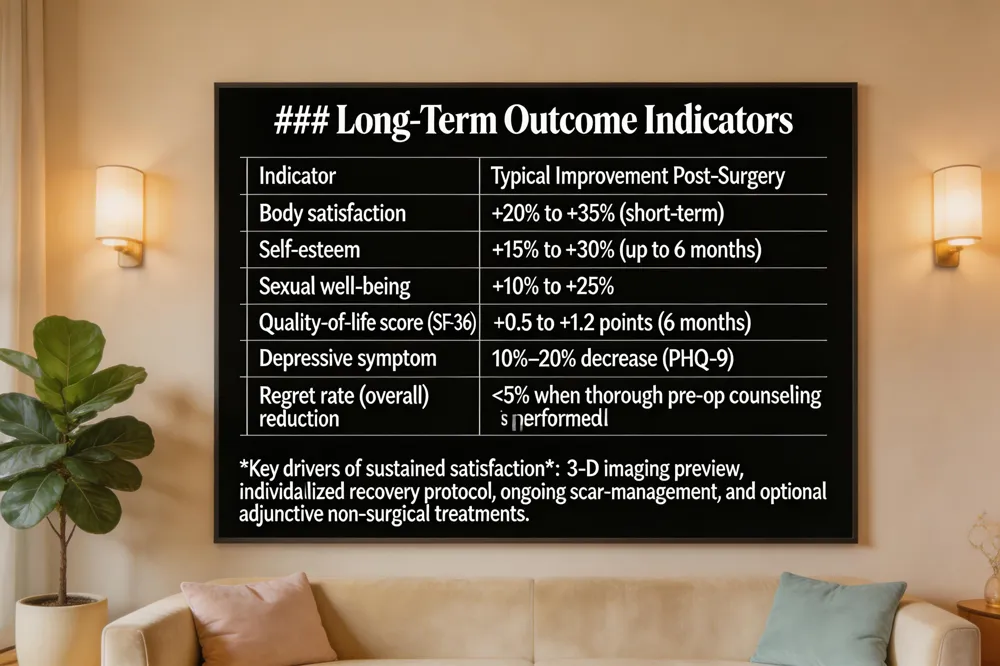 Successful aesthetic surgery begins with psychological preparedness and realistic expectations. Board‑certified surgeons at boutique practices such as Madison Plastic Surgery conduct thorough pre‑operative assessments that blend medical history, facial‑body analysis, and goal‑setting, often using 3‑D imaging to visualize outcomes. This personalized, concierge‑style approach helps patients understand what is surgically achievable, reducing postoperative regret and fostering mental‑health benefits. Systematic reviews of cosmetic procedures report short‑term gains in body satisfaction, self‑esteem, and sexual well‑being, while prospective studies show lasting improvements in quality‑of‑life scores and reductions in depressive symptoms up to six months post‑op. Ongoing follow‑up—including post‑surgical check‑ins, scar‑management protocols, and optional non‑surgical adjuncts—reinforces safety and refines results over time. Patient testimonials consistently highlight the surgeon’s artistic eye, meticulous technique, and compassionate communication as key drivers of satisfaction. By integrating rigorous safety standards, advanced imaging, and individualized care plans, high‑end clinics deliver natural, elegant outcomes that endure, reinforcing confidence and long‑term well‑being.
The Path Forward: Excellence in Every Detail
Plastic surgery thrives where artistic vision meets rigorous science, a synergy confirmed by modern data showing high patient satisfaction, low complication rates, and measurable gains in self‑esteem and quality of life. Madison Plastic Surgery embodies this harmony through boutique, personalized care, state‑of‑the‑art 3‑D imaging, and meticulous surgical planning that delivers natural, elegant results. We invite you to explore a collaborative consultation, where informed, individualized decisions lay the foundation for lasting confidence and refined aesthetic mastery.