Why Facial Volume Matters
Facial fullness is a hallmark of youthful vitality, yet natural aging gradually erodes the structural scaffolding that supports it. Beginning in the late twenties, collagen and hyaluronic acid production decline by roughly 1% per year, while bone resorption of the cheekbones, orbital rims, and jawline reduces the underlying framework. Simultaneously, sub‑cutaneous fat pads atrophy and migrate, leaving hollowed cheeks, deep nasolabial folds, and a sunken under‑eye region. These changes are not merely cosmetic; they alter facial proportions, convey fatigue, and can diminish confidence. A boutique, personalized approach—rooted in comprehensive facial analysis, individualized treatment planning, and the expertise of board‑certified plastic surgeons—ensures that each volume‑restoring intervention, whether hyaluronic‑acid filler, biostimulatory injectable, or autologous fat transfer, is tailored to the patient’s unique anatomy and aesthetic goals. This meticulous strategy delivers natural, elegant results while preserving safety and long‑term satisfaction.
Understanding Facial Volume Loss and Initial Treatment Strategies
Key Factors in Facial Volume Loss
| Age Range | Primary Tissue Changes | Typical Affected Areas |
|---|---|---|
| Late 20s‑30s | Decrease in collagen, hyaluronic acid, sub‑cutaneous fat | Cheeks, temples, under‑eye, lips |
| 40s‑50s | Progressive bone resorption + fat loss | Cheeks, nasolabial folds, jawline |
| 60s+ | Marked loss of soft‑tissue thickness and skin elasticity | Entire mid‑face, periorbital region |
Initial Treatment Decision Tree
| Goal | Recommended Modality | Expected Duration of Effect | Typical Downtime |
|---|---|---|---|
| Immediate volume boost | HA fillers (Restylane, Juvéderm, RHA) | 6‑24 months (depends on cross‑link) | 0‑2 days (bruising, mild swelling) |
| Long‑term structural support | Autologous fat grafting | 3‑7 years (30‑70 % graft take) | 5‑7 days (swelling, bruising) |
| Gradual collagen stimulation | Biostimulatory fillers (Sculptra, Radiesse) | 12‑24 months (collagen remodeling) | 1‑3 days |
| Subtle lift & tightening | PDO threads, Ultherapy | 12‑18 months (tightening) | Minimal (redness) |
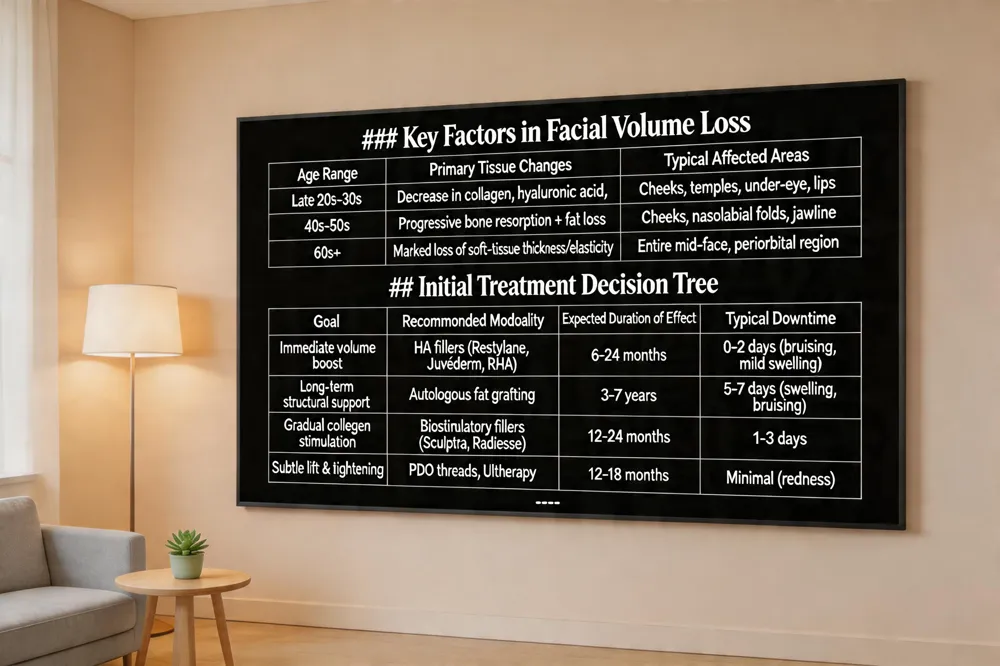 Facial volume loss begins in the late 20s as collagen, hyaluronic acid, and sub‑cutaneous fat diminish, while bone resorption further hollows the cheeks, temples, under‑eye area, and lips. At Madison Plastic Surgery a comprehensive facial analysis—reviewing bone structure, soft‑tissue thickness, and skin quality—guides a personalized restoration plan.
Face volume treatment
Restoring youthful fullness involves either autologous fat grafting, which uses your own purified fat for a natural, long‑lasting result, or a curated menu of FDA‑approved dermal fillers (HA products such as Restylane and Juvéderm, biostimulatory agents like Sculptra and Radiesse). Our board‑certified surgeons select the optimal modality to match your anatomy and aesthetic goals, delivering elegant, harmonious outcomes with minimal downtime.
Best facial volume loss treatments
A synergistic approach—combining surgical fat transfer for permanent structural support with high‑quality fillers for immediate plumpness—offers the most durable rejuvenation. Hyaluronic‑acid fillers (Restylane, Juvéderm, RHA) provide instant volume; collagen‑stimulating fillers (Sculptra, Radiesse promote gradual, long‑term gains. Non‑surgical lifts such as PDO threads or Ultherapy add subtle tightening while preserving natural movement.
Best treatment for loss of volume in face
For deep, lasting correction, autologous fat grafting is the gold standard. When a quick, customizable lift is desired, HA fillers, calcium‑hydroxylapatite, or poly‑L‑lactic‑acid injectables deliver immediate results that can be fine‑tuned over time.
How to address facial fat loss?
Targeted dermal fillers or fat transfer replenish hollowed regions; adjunctive skin‑tightening technologies (radiofrequency, ultrasound) and lifestyle measures—stable weight, hydration, balanced diet—support and prolong results.
Mid‑face volume loss treatment
Premium HA fillers such as Juvederm Voluma and Restylane Lyft, and RHA® restore cheek projection and smooth tear‑troughs with a natural, dynamic lift that lasts 12‑24 months, performed in a private boutique setting with only mild, transient swelling.
Dermal Fillers: Types, Costs, and Clinical Outcomes
Comparative Table of Popular Dermal Fillers
| Filler Type | Brand(s) | Main Component | Typical Longevity | Approx. Cost per Syringe* | Key Clinical Notes |
|---|---|---|---|---|---|
| Hyaluronic‑acid (HA) | Juvederm Voluma, Restylane Lyft, RHA® | Cross‑linked HA | 12‑24 months (depends on depth) | $700‑$2,000 | Reversible with hyaluronidase; excellent for cheek projection |
| Calcium‑hydroxylapatite | Radiesse | Calcium‑hydroxylapatite microspheres | 12‑18 months | $800‑$1,800 | Provides scaffold for collagen; not reversible |
| Poly‑L‑lactic‑acid (PLLA) | Sculptra | PLLA particles | Up to 2 years (gradual) | $900‑$2,200 | Stimulates neocollagenesis; requires multiple sessions |
| Polymethyl‑methacrylate (PMMA) | Bellafill | PMMA microspheres in collagen | 5‑10 years | $1,200‑$2,500 | Permanent; used for deep scars and volume loss |
*Costs are based on Madison Plastic Surgery’s NY boutique pricing and may vary with syringe count and anatomical complexity.
Safety Profile Overview
| Adverse Event | Frequency | Management |
|---|---|---|
| Swelling / bruising | Very common | Cold compress, elevation, NSAIDs |
| Vascular occlusion (rare) | <0.01 % | Immediate hyaluronidase, emergency care |
| Nodule formation (HA) | Uncommon | Massage, possible dissolution |
| Infection (fat graft) | Rare | Aseptic technique, antibiotics if needed |
 Facial volume loss is best addressed with a palette of injectable agents, each engineered for specific anatomy and longevity. Hyaluronic‑acid (HA) fillers such as Juvederm Voluma, Restylane Lyft, and the adaptable RHA® series provide immediate hydration‑driven lift, are reversible with hyaluronidase, and typically endure 6–24 months depending on cross‑link density and injection depth. Calcium hydroxylapatite (Radiesse) offers a denser scaffold that stimulates collagen and supports deeper contours for up to 18 months. Poly‑l‑lactic‑ (Sculptra) works gradually, invoking neocollagenesis for a subtle, two‑year restoration. Safety profiles across these products are favorable; most adverse events are transient swelling, bruising, or rare vascular occlusion, which is mitigated by board‑certified injectors trained in facial anatomy.
Midface filler cost – In a boutique New York practice like Madison Plastic Surgery, a comprehensive mid‑face rejuvenation requires 1–3 syringes of a medium‑to‑firm HA filler, ranging from $700 to $2,000 per syringe. The total investment typically falls between $1,400 and $6,000, reflecting product choice, anatomical complexity, and the surgeon’s expertise.
Midface filler before and after – Prior to treatment, patients exhibit flattened cheeks, deep nasolabial folds, and subtle tear‑trough hollows. After precise HA placement, the mid‑face gains three‑dimensional volume, the nasolabial folds soften, and the under‑eye area appears refreshed, with results visible instantly and refined as the filler integrates.
Best dermal fillers for facial volume – Juvederm Voluma, Restylane Lyft (or Defyne), and RHA® fillers are the most trusted for natural, long‑lasting cheek augmentation, offering 12–24 months of lift and the ability to be dissolved if needed.
Mid‑face volume loss filler – Hyaluronic‑acid (HA) fillers remain the first‑line solution, delivering smooth hydration and structural support while preserving dynamic facial expression.
Do fillers ruin your face? – Over‑volumizing or incorrect placement can cause undesirable results, but when performed by a skilled, board‑certified practitioner, fillers enhance rather than compromise natural beauty. Hyaluronic‑acid fillers can be safely reversed with hyaluronidase.
Mid‑face filler injection points – Optimal placement includes three zones: the lateral zygomatic arch (periosteal), the central malar apex, and a deep medial cheek point above the nasolabial fold, each injected with a 90‑degree angle for deep bolus or a shallow linear technique for seamless blending.
Is 70 too old for Botox and fillers? – Age alone does not preclude treatment; many patients over 70 achieve excellent results with appropriately dosed neuromodulators and fillers, maintaining a natural appearance while addressing evolving volume needs.
Autologous Fat Transfer: Procedure, Benefits, and Risks
Autologous Fat Grafting Workflow & Outcomes
| Step | Description | Critical Tips |
|---|---|---|
| 1️⃣ Harvesting | Gentle liposuction from abdomen, flanks, or thighs using low‑negative pressure | Preserve adipocyte viability; avoid over‑harvesting |
| 2️⃣ Purification | Centrifugation (≈300 g, 3 min) or filtration to remove oil, blood, anesthetic | Aim for a clean, uniform fat concentrate |
| 3️⃣ Injection | Micro‑droplet technique with blunt cannula, layering from deep (periosteal) to superficial | Inject 0.05‑0.1 ml per pass for optimal graft take |
| 4️⃣ Post‑op Care | Light compression, head elevation, limited facial pressure for 48 h | Minimize edema; monitor for irregularities |
Benefits vs. Risks
| Benefit | Detail |
|---|---|
| Natural‑looking volume | Uses patient’s own tissue; integrates with surrounding structures |
| Long‑lasting effect | 30‑70 % graft survival; results can persist 5‑7 years |
| Stimulates collagen | Stem‑cell‑rich fat promotes neocollagenesis |
| Low allergy risk | Autologous material eliminates immunologic reactions |
| Risk | Typical Incidence | Mitigation |
|---|---|---|
| Swelling / bruising | Very common (first 1‑2 weeks) | Cold compresses, elevation |
| Contour irregularities | Uncommon | Precise micro‑droplet placement |
| Fat necrosis / cyst | Rare (<1 %) | Adequate purification, gentle injection |
| Infection | Very rare | Sterile technique, prophylactic antibiotics if indicated |
| Fat embolism | Extremely rare | Avoid intravascular injection; use blunt cannula |
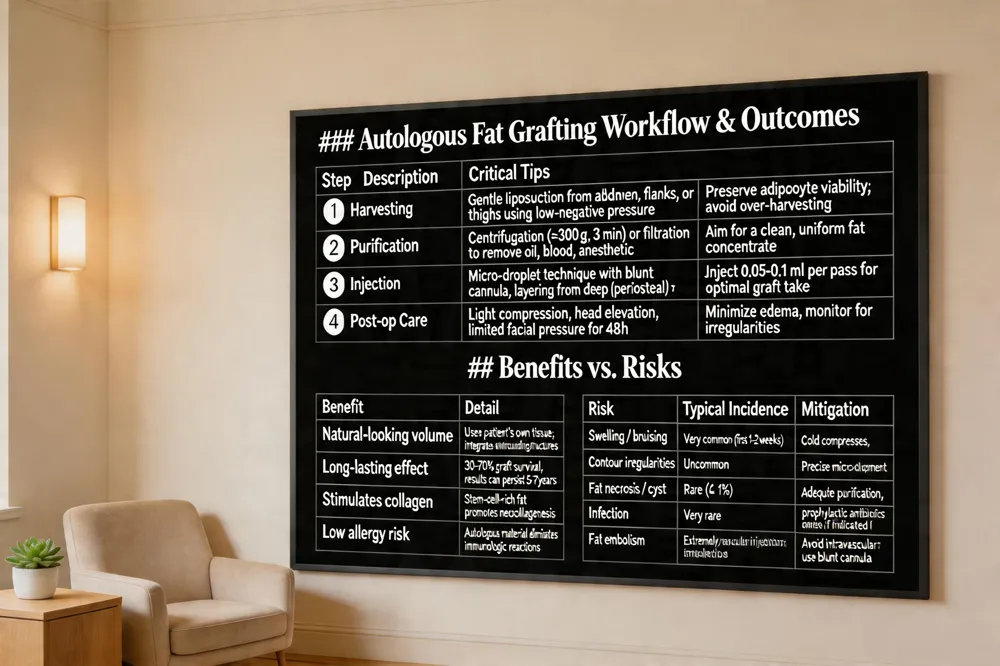 Autologous fat grafting begins with careful harvesting of healthy adipose tissue—most often from the abdomen, flanks, or thighs—using gentle liposuction that preserves cell viability. The harvested fat is then purified by centrifugation or filtration to remove oil, blood, and anesthetic, and finally injected in micro‑droplet aliquots through a blunt cannula into targeted facial zones such as the cheeks, nasolabial folds, tear‑troughs, and jawline. This meticulous technique maximizes graft survival, which studies show ranges from 30 %‑70 % after the initial healing phase, and allows the transferred stem‑cell‑rich tissue to integrate and stimulate collagen production, offering both immediate volume and long‑lasting regenerative benefits. While many patients retain meaningful fullness for five years or more, some resorption is inevitable; touch‑up sessions may be required to maintain the desired contour. Potential complications include bruising, swelling, contour irregularities, cyst formation, fat necrosis, and, rarely, infection or fat embolism. Recovery is typically mild, with most individuals resuming normal activities within a week; swelling subsides over 1‑2 weeks and final results become apparent by three months. Choosing a board‑certified facial plastic surgeon—such as those at Madison Plastic Surgery in New York City—ensures precise anatomy, optimal graft take, and a personalized, natural‑looking rejuvenation that aligns with high‑end aesthetic standards.
Natural and Complementary Approaches to Volume Restoration
Non‑Injectable Strategies for Facial Volume Support
| Modality | Category | Mechanism | Typical Frequency |
|---|---|---|---|
| Topical HA gels & moisturizers | Skincare | Attracts water to dermis → immediate plump | Daily |
| Retinoids & peptide serums | Skincare | Boosts collagen & elastin synthesis | Nightly |
| Vitamin C antioxidant serum | Skincare | Reduces oxidative damage, supports collagen | Daily |
| Hydrolyzed collagen supplements | Nutrition | Provides amino acids for dermal matrix | 10‑15 g per day |
| Omega‑3 fatty acids (fish oil) | Nutrition | Anti‑inflammatory, supports skin barrier | 1‑2 g daily |
| Radio‑frequency (RF) tightening | Device | Thermal collagen remodeling | 4‑6 sessions, 1 month apart |
| Ultherapy (micro‑focused ultrasound) | Device | Deep dermal heating → neocollagenesis | 1‑2 sessions per year |
| Microneedling‑RF | Device | Combines micro‑injury with RF for collagen | 3‑4 sessions, 4‑6 weeks apart |
| Facial massage / facial‑yoga | Lifestyle | Improves lymphatic drainage & muscle tone | 5‑10 min daily |
| Adequate sleep & stress management | Lifestyle | Hormonal balance for tissue repair | Ongoing |
| Broad‑spectrum SPF 30+ | Lifestyle | Prevents UV‑induced collagen breakdown | Daily reaply |
Integrated Routine Example
- Morning: Cleanser → Vitamin C serum → HA gel → SPF 30+
- Evening: Cleanser → Retinoid → Peptide serum → Moisturizer
- Nutrition: 10 g hydrolyzed collagen + 1 g omega‑3 + 2 L water
- Weekly: 30‑min facial‑yoga + 5‑min self‑massage
- Monthly: RF session (or Ultherapy every 6 months)
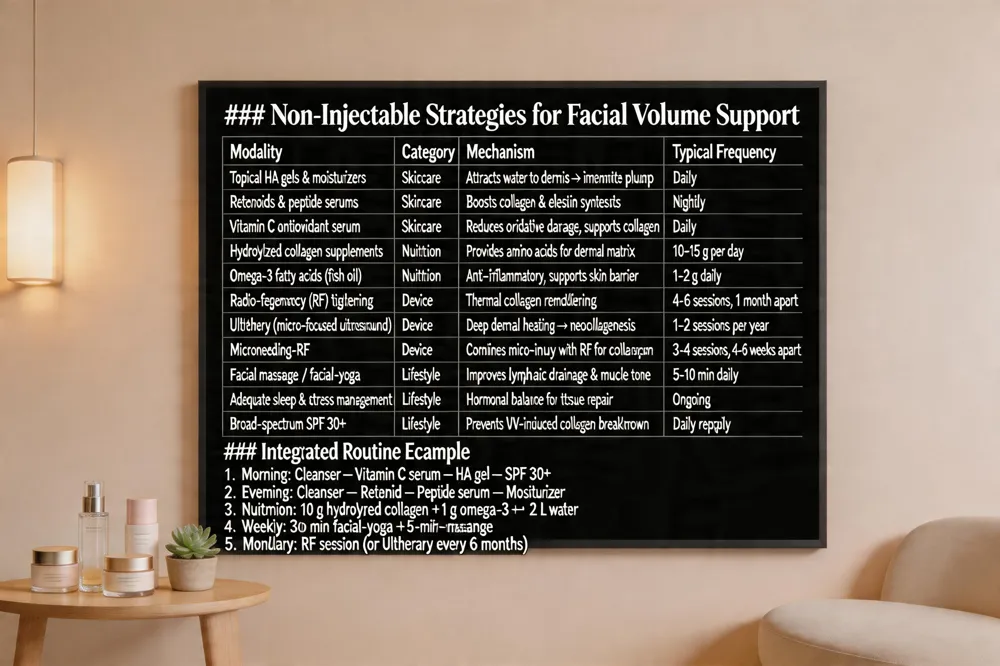 Restoring facial fullness without surgery begins with a disciplined skin‑care regimen that fuels collagen, elastin, and hyaluronic acid (HA) production. Retinoid‑based moisturizers and antioxidant‑rich serums (vitamin C, peptides, bakuchiol) stimulate dermal remodeling, while HA gels and moisturizers replenish extracellular matrix water‑binding capacity for immediate plumping. Internally, a protein‑focused diet, omega‑3 fatty acids, adequate hydration, and optional hydrolyzed‑collagen supplements provide the building blocks for resilient connective tissue.
Lifestyle choices further safeguard volume: daily broad‑spectrum SPF, avoidance of smoking and excessive alcohol, quality sleep, stress‑reduction, and maintenance of a stable, healthy weight prevent fat pad depletion and bone resorption. Gentle facial massage, facial‑yoga, and low‑impact resistance training preserve underlying muscle tone that supports facial contours.
Non‑injectable technologies complement these measures. Ultherapy, radio‑frequency tightening, and microneedling‑RF deliver controlled thermal energy that induces neocollagenesis, gradually thickening the dermis and offering a subtle lift. Combining these modalities with high‑performance topicals—such as VOL.U.LIFT™ GLP‑1 4D Skin Rebound Complex, which blends HA, peptide‑derived collagen fragments, and amino acids—creates a multi‑layered, natural‑looking volume enhancement.
Together, these evidence‑based strategies provide a sophisticated, boutique‑style path to a fuller, youthful face while preserving the safety and elegance patients expect from Madison Plastic Surgery.
Patient Journey: From Consultation to Maintenance
Typical Patient Pathway for Facial Volume Restoration
| Phase | Key Activities | Timeline | Follow‑up Actions |
|---|---|---|---|
| 1️⃣ Consultation | Full facial analysis, 3‑D imaging, discussion of goals, treatment plan selection | Day 0 | Patient education packet; consent forms |
| 2️⃣ Pre‑procedure Prep | Lab work (if needed), medication review, cessation of NSAIDs/aspirin | 1‑2 weeks before | Skin prep (cleanse, avoid retinoids 24 h) |
| 3️⃣ Treatment Day | HA filler injection or fat harvest & graft; optional thread lift or Ultherapy | Day 0 | Immediate post‑procedure instructions |
| 4️⃣ Immediate Recovery | Cold compresses, head elevation, avoid strenuous activity | Days 1‑3 | Phone check‑in on Day 2 |
| 5️⃣ Early Healing | Swelling subsides, light activity resumes | Days 4‑14 | Gentle facial massage (if approved) |
| 6️⃣ Mid‑term Evaluation | Assess graft take / filler integration, address minor irregularities | 6‑8 weeks (fat) or 2‑4 weeks (HA) | Optional touch‑up or smoothing session |
| 7️⃣ Maintenance | Scheduled touch‑ups (HA every 9‑12 months; fat graft review annually) | Ongoing | Lifestyle and skincare reinforcement |
Day‑by‑Day Fat Transfer Recovery Snapshot
| Day | Expected Symptoms | Recommended Care |
|---|---|---|
| 1 | Moderate swelling, bruising, mild discomfort | Elevate head, apply cold packs 15 min/hr |
| 2‑3 | Peak swelling, possible numbness | Continue cold therapy, avoid facial massage |
| 4‑5 | Swelling begins to recede | Light facial movements, gentle cleansing |
| 6‑10 | Majority of swelling gone | Resume normal activities, light exercise |
| 11‑14 | Near‑normal appearance | Begin soft facial massage if advised |
| 6‑8 weeks | Full graft integration visible | Final assessment, discuss long‑term plan |
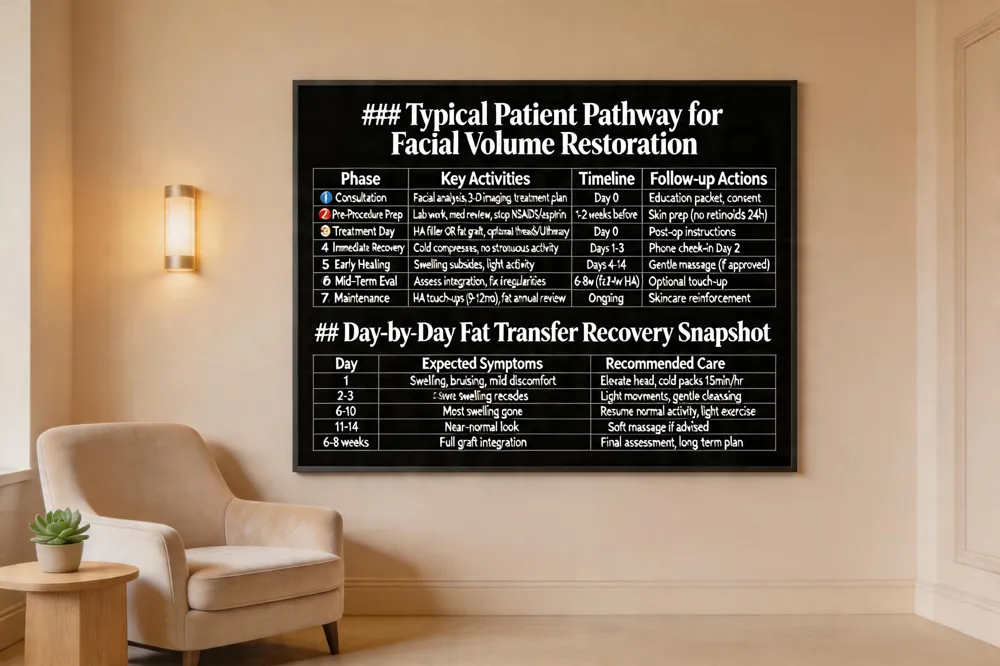 A personalized evaluation begins with a thorough facial analysis at Madison Plastic Surgery, where board‑certified surgeons map each patient’s unique anatomy, discuss aesthetic goals, and recommend the optimal mix of hyaluronic‑acid fillers, biostimulatory injectables, or autologous fat transfer. Post‑procedure care is tailored to the chosen modality: fillers require minimal downtime—cold compresses, head elevation, and avoidance of blood‑thinners for 24‑48 hours—while fat grafting involves a brief swelling phase, gentle compression, and limited activity for the first week, with full contour refinement emerging by 6‑8 weeks and final stability at three to six months. Long‑term maintenance includes scheduled touch‑ups (typically every 9‑12 months for HA fillers) and periodic evaluation of graft survival, allowing adjustments to preserve natural fullness over years.
Addressing facial volume loss with fillers and fat transfer near – Immediate restoration is achieved with HA fillers (e.g., Juvederm, Restylane) lasting 6‑18 months; calcium‑hydroxylapatite or PLLA fillers extend support to 12‑24 months. Autologous fat transfer offers a semi‑permanent solution by harvesting and re‑injecting the patient’s own fat, requiring a brief recovery and delivering lasting, natural volume.
Sudden loss of volume in face – Rapid changes from weight loss, hormonal shifts, or lifestyle factors cause hollowed cheeks and tear‑troughs. A customized plan combines premium fillers for quick lift and, when appropriate, minimally invasive laser or surgical techniques to restore balanced contour.
Day‑by‑day fat transfer recovery – Day 1: swelling, bruising, head elevated. Days 2‑3: peak swelling, cold compresses, limited activity. Days 4‑5: swelling subsides, light tasks resume. By 10‑14 days most patients return to normal life; full graft integration appears by 6‑8 weeks.
Mid‑cheek filler before and after – Visible lift within 1‑2 weeks, restoring cheekbone projection and youthful fullness using Restylane Lyft or Contour.
Facial fat transfer before and after – Hollow cheeks and temples gain soft, natural volume, with a subtle lift that harmonizes facial proportions and endures for years.
How to restore lost volume in face? – Begin with a personalized assessment, employ HA fillers for immediate fill, consider calcium‑hydroxylapatite or PLLA for longer‑lasting collagen stimulation, and opt for autologous fat transfer for permanent, natural‑looking restoration, complemented by skin‑tightening technologies for optimal, elegant results.
Your Path to Timeless Elegance
Facial volume loss can be expertly corrected with two complementary modalities: hyaluronic‑acid dermal fillers for immediate, reversible plumping, and autologous fat grafting for longer‑lasting, natural‑looking restoration. Fillers such as Juvederm®, Restylane® and RHA® provide 6‑12 months of lift in the cheeks, under‑eye troughs, lips and jawline, while biostimulatory agents (Radiesse®, Sculptra®) add collagen support. Fat transfer harvests the patient’s own tissue, processes it, and injects it in micro‑droplets to achieve semi‑permanent volume and improved skin quality, though a modest portion may resorb over time. The decisive factor in achieving elegant, safe results is a board‑certified plastic surgeon who conducts a thorough facial analysis, discusses aesthetic goals, and tailors a staged plan—often combining fillers for instant correction with fat grafting for durable contour. Prospective patients should schedule a personalized consultation, during which the surgeon will map target zones, review medical history, and outline recovery expectations, paving the way toward a confident, youthful appearance.