Introduction
In high‑end cosmetic surgery, scar placement is as critical as the operative result itself; a well‑concealed incision preserves the natural elegance of the face and body while reinforcing patient confidence. Surgeons at Madison Plastic Surgery align every incision with relaxed skin tension lines (Langer’s lines) or dynamic facial wrinkle patterns, ensuring that the scar runs parallel to the skin’s inherent stress vectors. This strategy minimizes widening, reduces hypertrophic risk, and allows the scar to blend seamlessly into creases, hair‑bearing zones, or aesthetic unit boundaries. Our comprehensive scar‑management protocol begins pre‑operatively with meticulous 3‑D imaging and patient‑specific risk assessment, proceeds intra‑operatively with fine monofilament sutures, tension‑free layered closure, and meticulous hemostasis, and continues post‑operatively with silicone gel sheeting, sun protection, gentle massage, and adjunctive laser or microneedling as needed. The result is a discreet, natural‑looking scar that complements the refined aesthetic outcomes our discerning clientele expect.
Principles of Strategic Incision Placement
Key Principles for Incision Placement
| Principle | Details |
|---|---|
| Alignment | Cuts parallel to Langer’s lines and relaxed skin‑tension lines to minimize mechanical stress. |
| Natural Creases | Position incisions within natural folds (nasolabial, hairline, pre‑auricular) or aesthetic units for seamless blending. |
| Pre‑operative Planning | Use 3‑D imaging and pinch test to map skin laxity and determine optimal orientation respecting static and dynamic tension vectors. |
| Tension Management | Deliberate placement reduces visual prominence and supports optimal healing. |
| Outcome Goal** |
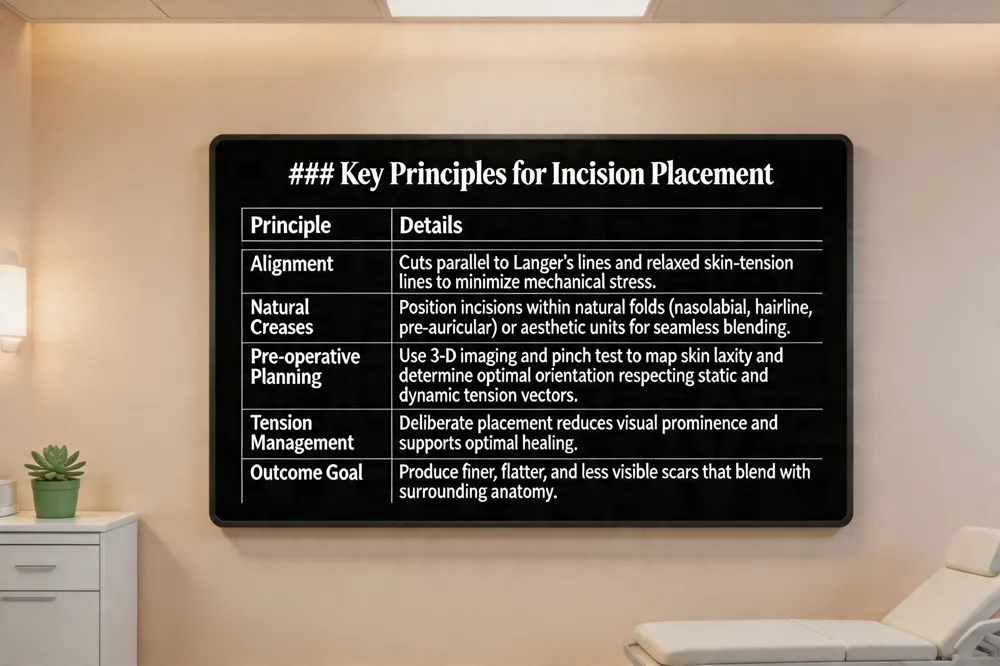 Strategic incision placement is the cornerstone of elegant, natural‑looking results in high‑end plastic surgery. By aligning cuts parallel to Langer’s lines and relaxed skin‑tension lines, surgeons minimize mechanical stress and the hypert of scar widening, producing finer, flatter lines. Incisions are deliberately positioned within natural creases, hair‑bearing zones, or within aesthetic units—such as the nasolabial fold, hairline, or pre‑auricular crease—so that the scar blends seamlessly with surrounding anatomy. Advanced pre‑operative planning utilizes 3‑D imaging and the pinch test to map skin laxity, allowing precise orientation that respects both static and dynamic tension vectors. This meticulous approach reduces the visual prominence of the scar and supports optimal healing.
Surgical scar healing stages: Surgical scar healing follows a predictable four‑stage process. First, hemostasis occurs immediately after the incision, when blood clots form to stop bleeding and platelets release signals that kick‑off repair. Next, the inflammation phase lasts a few days, characterized by redness, swelling, and mild tenderness as white blood cells clear debris and protect against infection. The proliferation stage, from about one week to six weeks, builds new tissue and collagen, causing the scar to appear pink, firm, and slightly raised as it begins to close. Finally, the remodeling (remodeling) phase extends from three months to a year, during which collagen fibers reorganize, the scar flattens and softens, and its final color and texture become more like the surrounding skin.
Intra‑operative Techniques for Tension‑Free Closure
Intra‑operative Techniques for Tension‑Free Closure
| Technique | Application | Benefits |
|---|---|---|
| Fascial Incision | Precise cut through dense connective tissue (deep‑plane or sub‑SMAS) with strict hemostasis. | Provides strong structural support with minimal skin disruption. |
| Fine Absorbable Sutures | Subcuticular closure using fine absorbable material. | Reduces scar visibility, eliminates need for suture removal. |
| Silicone Occlusion | Immediate postoperative silicone gel or sheet. | Modulates collagen deposition, flattens scar. |
| Tension‑Free Layering | Layered closure (deep fascia → subcutaneous → skin) to distribute forces. | Prevents wound edge tension, minimizes widening. |
| Meticulous Hemostasis | Control bleeding before closure. | Reduces inflammation and subsequent hypertrophic response. |
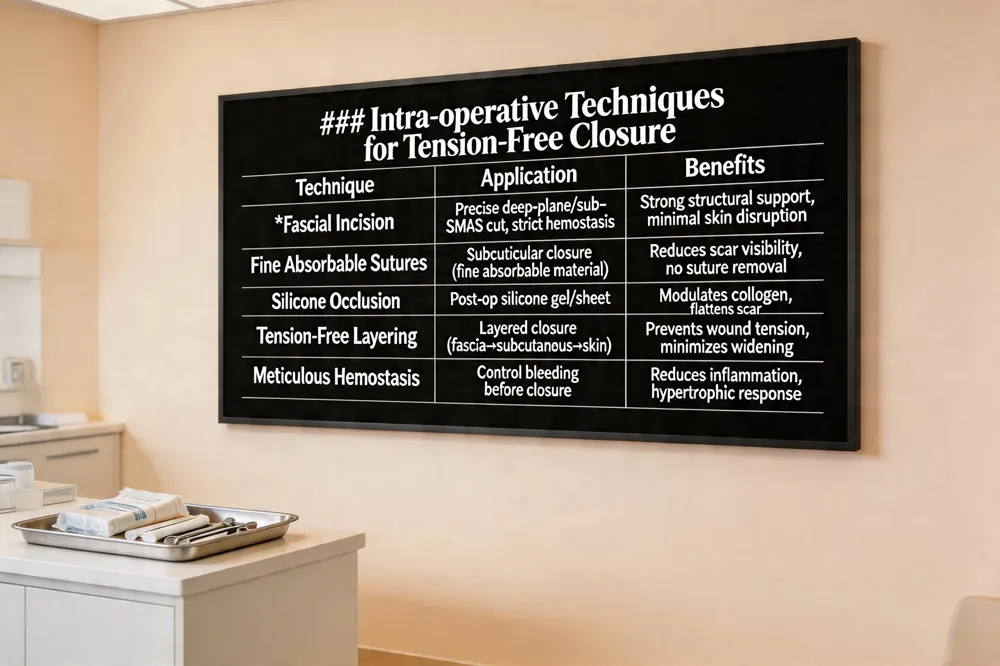 Fascial incision – A fascial incision is a precise cut through the dense connective tissue that envelopes muscles, granting access to deeper planes without disrupting the skin. In facial rejuvenation, deep‑plane or sub‑SMAS fascial releases are performed under strict hemostasis and closed with fine absorbable sutures, providing strong support and minimal scarring. Madison Plastic Surgery utilizes this technique only when it enhances structural stability and the natural, elegant result desired by our discerning clients.
How to prevent scarring from stitches on face – Adhere strictly to postoperative instructions: keep the incision clean and dry, protect it with a breathable dressing until sutures are removed, then apply silicone gel or sheets and perform gentle scar massage as directed. Shield the area with broad‑spectrum SPF 30+ sunscreen or a hat to prevent UV‑induced hyperpigmentation. Avoid tension by not picking, scratching, or pulling at the scar, and maintain skin hydration. For persistent concerns, consider adjunctive laser or microneedling under the guidance of a board‑certified plastic surgeon to achieve a flat, natural‑looking result.
Post‑operative Care Protocols for Optimal Healing
Post‑operative Care Protocols for Optimal Healing
| Phase | Action | Duration |
|---|---|---|
| Moisture Management | Apply petroleum jelly or silicone gel thinly. | Immediately post‑op → 2‑3 weeks. |
| Silicone Therapy | Silicone gel sheets 12 h/day. | 3‑4 months (after initial 2‑3 weeks). |
| Sun Protection | Broad‑spectrum SPF 30‑50 sunscreen or protective clothing. | 12‑18 months continuously. |
| Scar Massage | Fingertip pressure 1‑2 min, 1‑3 times daily. | Start 3‑4 weeks post‑op, after surgeon clearance. |
| Lifestyle Support | Vitamin C, zinc, protein‑rich diet, adequate hydration, smoking cessation. | Ongoing, at least 1 month pre‑ and post‑op. |
| Adjunctive Treatments | Consider laser, microneedling, steroid injections for persistent scars. | Typically after 3‑6 months, per surgeon recommendation. |
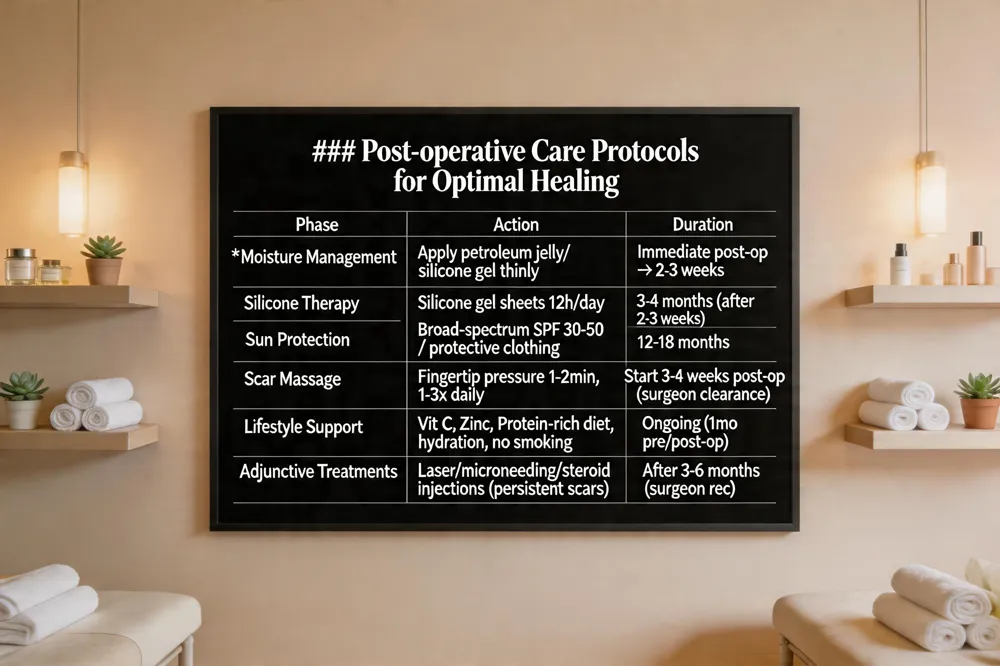 Maintaining optimal moisture is the cornerstone of scar management. Immediately after incision closure, apply a thin layer of petroleum jelly or a silicone‑based gel to keep the wound moist; after the first 2–3 weeks, transition to silicone gel sheets worn 12 hours daily for 3–4 months to regulate collagen deposition and flatten the scar.
Sun protection is non‑negotiable. Broad‑spectrum SPF 30‑50 sunscreen or protective clothing—should be applied whenever the scar is exposed and continued for 12‑18 months to prevent hyper‑pigmentation and collagen degradation.
Gentle scar massage begins once the surgeon clears the site, typically 3‑4 weeks post‑op. Use fingertip pressure for 1‑2 minutes, 1‑3 times daily, to align collagen fibers, reduce tethering, and improve pliability.
Lifestyle support accelerates healing: a diet rich in vitamin C, zinc, protein, and adequate hydration supplies the substrates for collagen synthesis; smoking cessation for at least one month pre‑ and post‑op restores microvascular flow and reduces hypertrophy risk.
When to start scar treatment after surgery – Begin silicone therapy and massage after the incision is fully closed (≈3‑4 weeks) with surgeon approval, and protect with SPF 30‑50 for the next 12‑18 months.
How to reduce surgery scars naturally – Keep the wound clean, moisturized with silicone or petroleum jelly, massage with vitamin E oil, protect from UV, eat a nutrient‑dense diet, stay hydrated, and avoid smoking or tension.
How to fade surgical scars – Apply silicone products twice daily, massage gently, shield from sun, and maintain low tension for six weeks; consider laser or steroid options if the scar persists.
How to make facial scars heal faster – Use petroleum jelly or silicone, massage after four weeks, apply SPF 30+ sunscreen, avoid picking or heat, and seek professional interventions for persistent elevation.
Does Vaseline help scars go away? – Vaseline provides occlusion and comfort, smoothing the surface, but does not remodel collagen; silicone gels and adjunctive therapies offer superior reduction of scar prominence.
Adjunctive Therapies & Emerging Modalities
Adjunctive Therapies & Emerging Modalities
| Therapy | Mechanism | Typical Timing | Key Benefits |
|---|---|---|---|
| Fractional CO₂ Laser | Creates micro‑columns of vaporized tissue → orderly collagen remodeling. | 6‑12 weeks post‑op (after inflammation). | Flattens hypertrophic/keloid scars, improves texture. |
| Pulsed‑Dye Laser (PDL) | Targets vascular components → reduces erythema, color mismatch. | 6‑12 weeks post‑op. | Improves scar coloration, reduces redness. |
| Microneedling + PRP/Growth‑Factor Serum | Micro‑injuries stimulate fibroblasts; PRP adds growth factors. | 4‑6 weeks post‑op, repeated every 4‑6 weeks. | Accelerates elastin & type I collagen deposition, smoother scar. |
| Radio‑Frequency Microneedling | Sub‑dermal heat contracts scar bundles, promotes neocollagenesis. | 6‑12 weeks post‑op for thick hypertrophic tissue. | Ideal for deep, raised scars; reduces thickness. |
| AI‑Guided 2026 Scar‑Treatment Protocol | High‑resolution scanning + AI‑driven energy modulation; precise delivery of laser, RF, and regenerative injectables. | Personalized schedule; typically begins after early remodeling phase. | Bespoke, multimodal refinement with minimal downtime. |
| Silicone Gel Sheets | Semi‑occlusive barrier maintains moisture, modulates collagen. | 3‑4 months continuous use. | Reduces scar height, redness, and pliability‑. |
| Steroid Injections | Intralesional corticosteroids suppress fibroblast activity. | For hypertrophic/keloid scars refractory to silicone. | Decreases scar bulk and itching. |
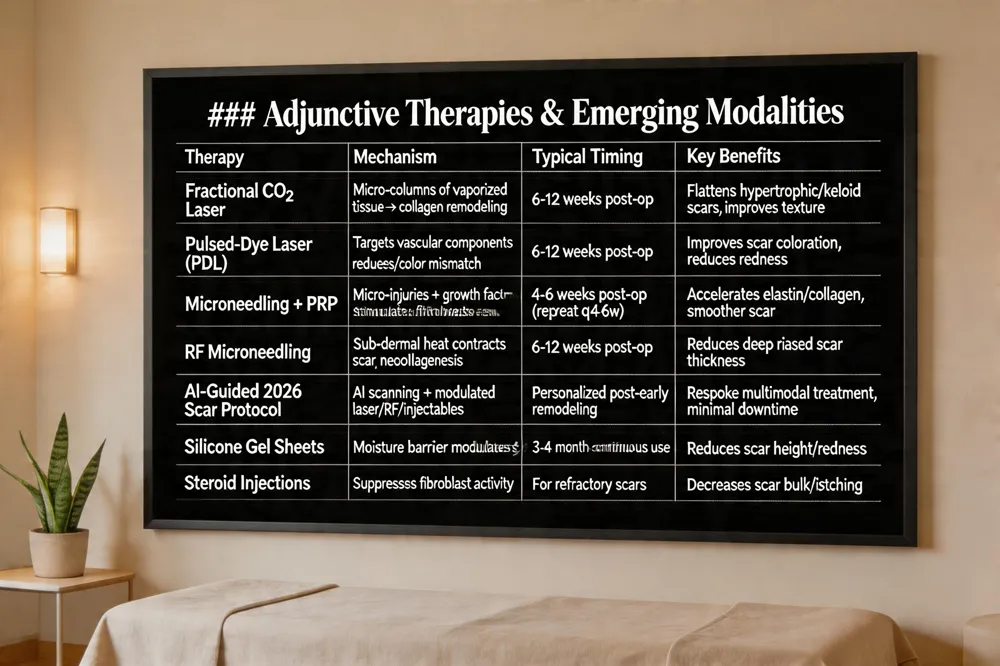 In the quest for scar refinement, Madison Plastic Surgery integrates evidence‑based adjuncts and forward‑thinking technologies.
Fractional CO₂ and Pulsed‑Dye Laser Resurfacing – Fractional CO₂ lasers create microscopic columns of vaporized tissue that stimulate orderly collagen remodeling, flattening hypertrophic or keloid scars and improving texture. Pulsed‑Dye lasers target vascular components, reducing erythema and enhancing color match. Clinical data consistently show superior outcomes when these modalities are applied after the early inflammatory phase (typically 6‑12 weeks post‑op) and combined with silicone occlusion.
Microneedling with PRP or Growth‑Factor Serums – Microneedling induces controlled micro‑injuries that activate fibroblasts; when paired with platelet‑rich plasma or serums rich in fibroblast‑stimulating growth factors, the procedure accelerates elastin and type I collagen deposition, yielding smoother, more pliable scars.
Radio‑Frequency Microneedling for Hypertrophic Tissue – RF microneedling adds sub‑dermal heat, penetrating deeper than conventional microneedling. The thermal effect contracts dense scar bundles and promotes neocollagenesis, making it ideal for thick, raised facial or body scars.
AI‑Guided 2026 Scar‑Treatment Protocol – The newest protocol marries high‑resolution scanning with AI‑driven energy modulation. Real‑time mapping of scar depth, density, and collagen orientation directs fractional laser and RF microneedling output, while regenerative injectables (exosomes, fibroblast‑stimulating biologics) are delivered precisely into micro‑channels. This personalized, multimodal regimen delivers natural‑looking refinement with minimal downtime.
Answering Patient Queries – The most effective aesthetic scar treatment remains fractional laser therapy, complemented by Microneedling + PRP for regenerative results; RF microneedling excels for deep hypertrophic tissue. The AI‑Guided 2026 protocol represents the next breakthrough, integrating imaging, laser, RF, and biologic injectables for bespoke care. Older scars are best addressed with a combination of laser resurfacing, Microneedling, silicone compression, and, when necessary, surgical revision. Facial scars benefit from a tailored blend of fractional CO₂ or erbium laser and Microneedling with growth‑factor serums, while internal scar tissue after surgery improves through guided massage, stretching, proper nutrition, and silicone or therapeutic taping. To make any scar less visible, patients should maintain a moisturized environment, perform regular scar massage, protect from UV with SPF 30+, and consider silicone sheets, steroid injections, or laser therapy under expert supervision.
Specialized Scenarios & Scar Types
Specialized Scenarios & Scar Types
| Scar Type | Characteristics | First‑line Management |
|---|---|---|
| Hypertrophic Scar | Thick, raised, confined to wound borders; pink, itchy, tender. | Silicone sheets/ointment 12 h/day (3‑4 months), intralesional steroids, early massage, laser if needed. |
| Cleft‑Palate Scar (Adult) | Thickened texture along historic repair line; may affect oral function. | Excision with layered muscle repositioning, dermal‑fat grafting; adjunctive fractional CO₂ laser, microneedling, silicone. |
| Pfannenstiel Incision | Low transverse “bikini‑line” scar; concealed under pubic hair. | Subcuticular absorbable sutures, silicone gel, sun protection. |
| Top Surgery (Keyhole) | Small periareolar puncture; scar fades within months. | Silicone gel, sunscreen, gentle massage; monitor for hypertrophy. |
| Top Surgery (Double‑Incision) | Longer chest wall scar; may use Z‑plasty/W‑plasty for camouflage. | Tension‑free closure, silicone, compression garments, laser for remodeling. |
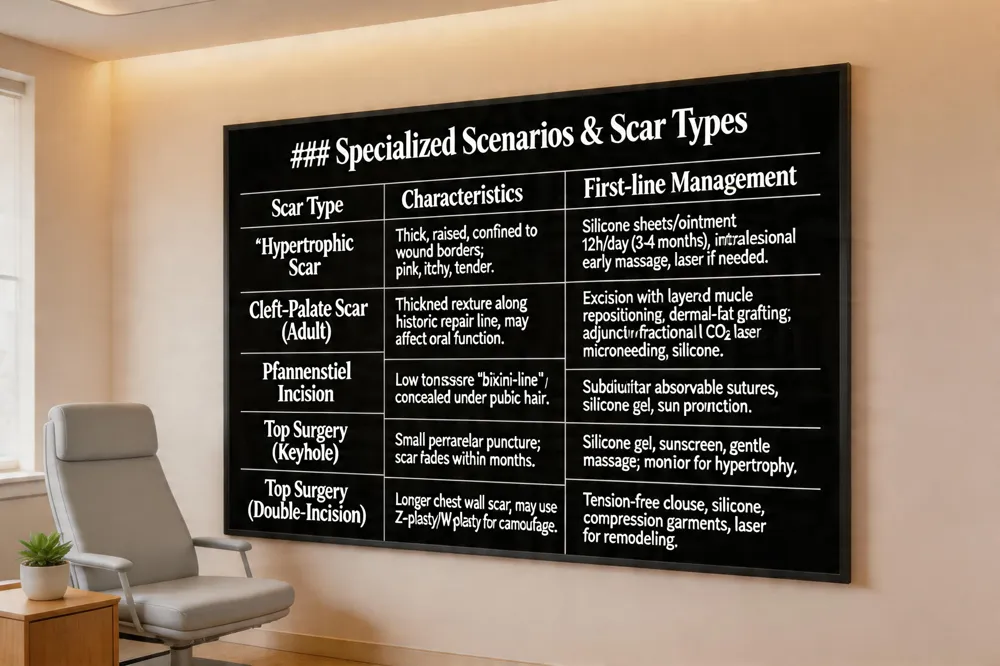 Hypertrophic scar
A hypertrophic scar is a thick, raised scar confined within the original wound borders, arising from excess collagen deposition during the proliferative phase of healing. It most often appears in high‑tension areas (e.g., the chest or back) and may be pink, itchy, or tender. Evidence‑based management includes silicone gel sheets or silicone-based ointments or sheeting (12 h / day for 3–4 months), intralesional corticosteroid injections, early scar massage, and, when needed, laser resurfacing or surgical revision. Early, personalized after‑care accelerates remodeling and yields a flatter, more natural result.
Cleft‑palate scar in adults
Adult patients may notice thickening or textural changes in the historic cleft‑palate repair line, which can affect facial harmony and oral function. A craniofacial surgeon can excise the scar, perform layered muscle repositioning, and graft dermal‑fat or collagen to restore a smooth contour. Adjunctive modalities—fractional CO₂ laser, microneedling, or silicone gel—further soften texture without additional incisions, delivering a discreet, elegant appearance.
Pfannenstiel incision
The low transverse “bikini‑line” Pfannenstiel incision follows relaxed skin tension lines, allowing a concealed scar beneath the pubic hair. Fine subcuticular sutures or absorbable monofilament provide edge eversion and minimal tension, resulting in a thin, well‑blended line that aligns with boutique aesthetic standards. Sun protection and silicone gel support optimal maturation.
Top surgery scars & keyhole technique
Keyhole (periareolar) top surgery uses a 4‑mm puncture or a short lower‑areolar incision, producing a scar that fades within months when silicone gel, sunscreen, and gentle scar massage are employed. Larger double‑incision or periareolar approaches yield longer lines that can be contoured to follow natural chest wall curves, often combined with Z‑plasty or W‑plasty for camouflage. Tailored scar‑placement planning ensures a natural‑looking, confidence‑restoring outcome.
Celebrity Scar Strategies & Public Perception
Celebrity Scar Strategies & Public Perception
| Strategy | How It Works | Typical Timing |
|---|---|---|
| Medical‑grade Silicone Gel/Sheets | Creates semi‑occlusive moisture barrier, modulates collagen. | Start 3‑4 weeks post‑op; 12 h/day for 3‑4 months. |
| Prescription Retinoids | Accelerates epidermal turnover, evens color. | Begin after incision fully closed, under dermatologist supervision. |
| Laser Resurfacing (CO₂, PDL) | Vaporizes scar tissue, remodels collagen, reduces erythema. | 6‑12 weeks post‑op (after inflammation subsides). |
| Incision Concealment | Align incisions with hairlines, natural creases, or aesthetic units. | Planned pre‑operatively. |
| High‑Coverage Camouflage Makeup | Tinted moisturizers or foundations match skin tone without clogging pores. | Daily use after silicone phase. |
| Compression Garments | Applies constant pressure (15‑30 mm Hg) to flatten scar. | 23 h/day for 6‑12 weeks. |
| Sun Protection (SPF 30+) | Prevents hyper‑pigmentation and collagen degradation. | Continuous for 12‑18 months post‑op. |
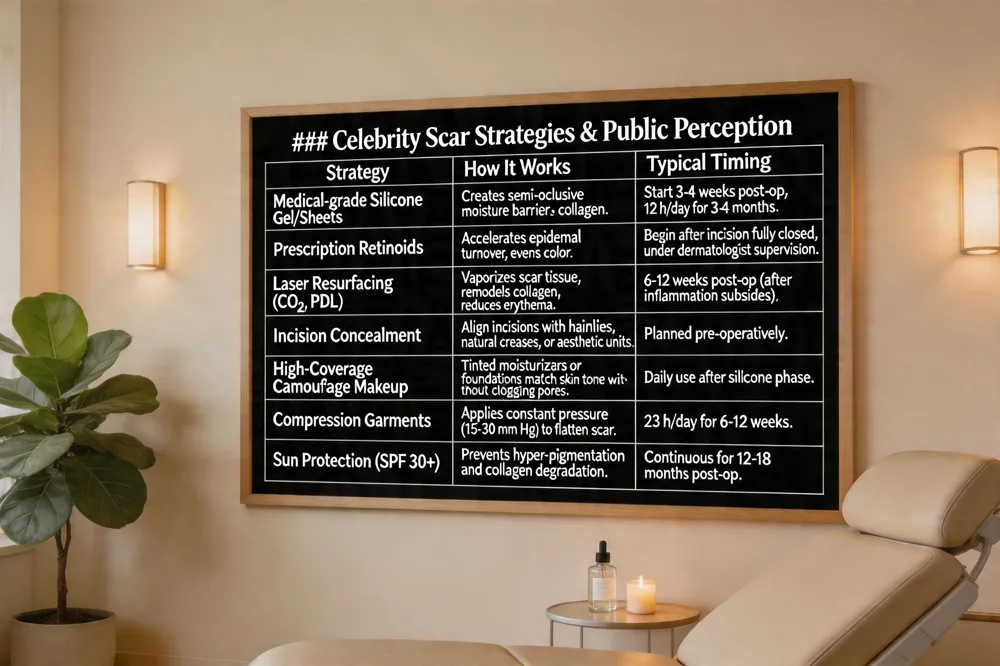 Celebrities achieve near‑invisible scars through a multimodal protocol that blends surgical precision with elite postoperative care.
Medical‑grade silicone, retinoids and laser resurfacing – After incision closure, a silicone‑based gel or sheet is applied for 12 hours daily for 3–4 months, maintaining a moist environment that modulates collagen deposition. Prescription‑strength retinoids accelerate epidermal turnover, while laser resurfacing during the remodeling phase remodel scar tissue, flatten height and normalize color.
Incision concealment behind hairlines and creases – Pre‑operative planning aligns incisions with relaxed skin tension lines (Langer’s lines) and situates them within natural folds—behind the ear, within the hairline or along nasolabial creases—so that the scar blends seamlessly with surrounding anatomy. Fine, absorbable subcuticular sutures and tension‑free closure further minimize visibility.
High‑coverage breathable makeup and tinted moisturizers – For day‑to‑day events, board‑certified dermatologists prescribe silicone breathable, high‑coverage foundations or tinted moisturizers that match the patient’s undertone, providing concealment without clogging pores.
Routine follow‑up and compression garment use – Patients attend scheduled visits for scar assessment, silicone compliance, and early detection of hypertrophy. Compression garments (15‑30 mm Hg) worn 23 hours daily for 6–12 weeks reduce mechanical tension, supporting a flatter, more elegant scar.
Answering your key questions
- How do celebrities hide their scars? They combine silicone gel, retinoids, laser resurfacing, strategic incision placement, professional camouflage makeup, and disciplined after‑care with compression and sun protection (SPF 30+).
- How to stop scarring on the face? Gentle cleansing, moist occlusion (petroleum jelly or silicone), UV protection (SPF 30+), tension‑free healing, and early interventions such as silicone sheets or laser therapy under surgeon guidance.
- How to make a scar less visible? Consistent silicone massage, sunscreen, silicone dressings, steroid injections or laser resurfacing for mature scars, and expertly matched skin‑camouflage products, followed by a personalized consultation at Madison Plastic Surgery for boutique‑level refinement.
Cost, Consultation & Personalized Planning
Cost, Consultation & Personalized Planning
| Component | Typical Range | Inclusions |
|---|---|---|
| Scar Revision Surgery | $1,200 – $5,000 | Surgeon fee, facility, anesthesia, post‑procedure garments. |
| Financing Options | CareCredit, in‑house payment plans | Flexible monthly installments. |
| Consultation | Complimentary or nominal fee (varies) | Personalized scar assessment, treatment plan, cost estimate. |
| Insurance Coverage | Generally not covered (elective) | May cover related medical necessity in rare cases. |
| Follow‑up Visits | Included in initial fee | Scar monitoring, silicone compliance checks, adjustment of adjunctive therapies. |
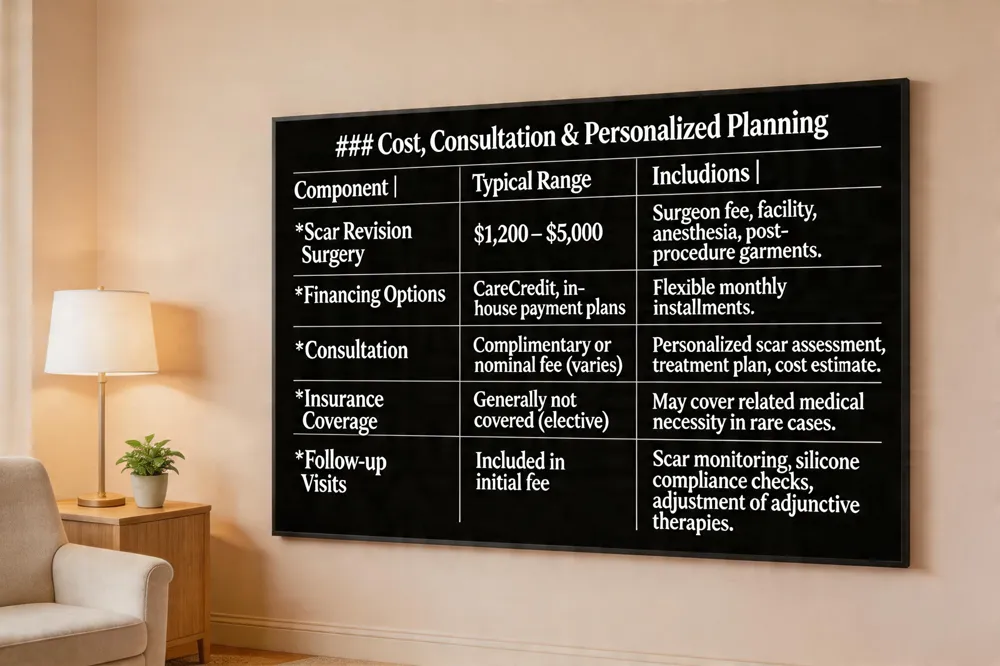 Scar revision surgery cost at a boutique New York practice typically ranges from $1,200 to $5,000, reflecting scar size, location and technique—simple excision, flap, graft or laser‑assisted resurfacing. The fee includes the surgeon’s charge, facility expenses, anesthesia and post‑procedure garments. Because revision is elective, most insurance does not cover it, but financing or CareCredit options are offered. Madison Plastic Surgery provides an itemized estimate during consultation and tailors payment plans to each client’s lifestyle.
The gold‑standard scar therapy is medical‑grade silicone gel, which creates a breathable, semi‑occlusive barrier that maintains moisture, modulates collagen deposition and reduces thickness and redness. Apply the gel twice daily once the incision is fully closed (about two weeks after surgery) for 8–12 weeks. Silicone sheets work similarly but conform better to irregular contours; both should be fragrance‑free and physician‑formulated.
Conservative scar management—silicone moisturization, gentle massage, pressure or tape, UV protection—remains cornerstone of soft, scars. Patient factors such as skin type, smoking, diabetes control and nutrition are addressed and post‑operatively to optimize outcomes.
Conclusion
Strategic incision placement—aligned with natural skin creases, Langer’s lines, and aesthetic units—combined with meticulous, tension‑free suturing and a moist, protected wound environment, sets the foundation for an imperceptible scar. At Madison Plastic Surgery, we elevate this science with personalized postoperative protocols that include silicone gel therapy, vigilant UV protection, and targeted scar massage, all calibrated to each patient’s skin type, genetic predisposition, and lifestyle. Our boutique approach guarantees that every procedure is planned and executed to blend seamlessly with the patient’s unique anatomy, delivering natural‑looking, elegant results that restore confidence. We invite you to schedule a private consultation, where our board‑certified surgeons will design a customized scar‑management plan that reflects the highest standards of safety, artistry, and individualized care.